PDF下载 ( 2134 KB)

肝硬化失代偿的危险因素及列线图模型构建
DOI: 10.12449/JCH260614
Risk factors for decompensated liver cirrhosis and the construction of a nomogram prediction model
-
摘要:
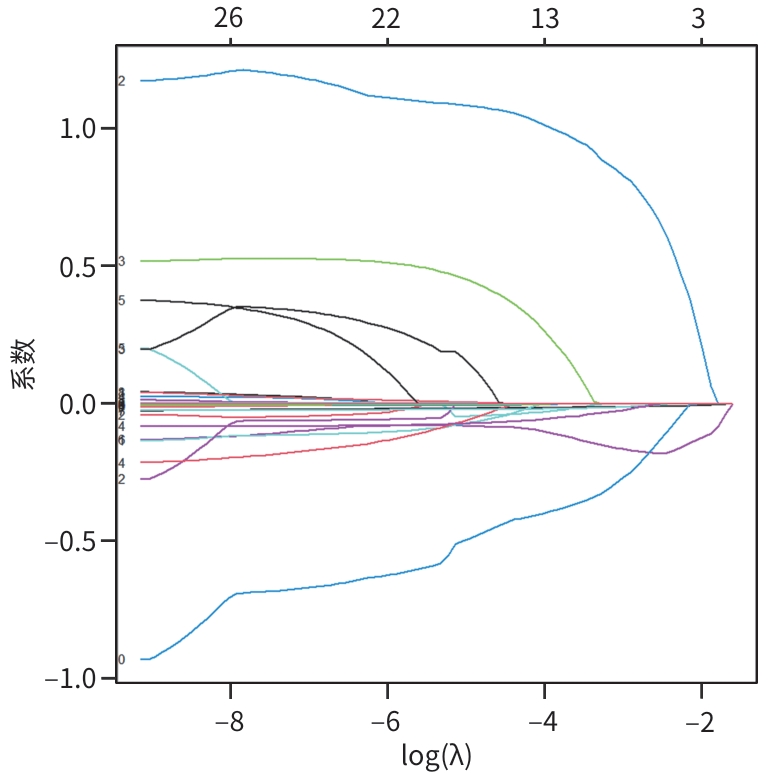
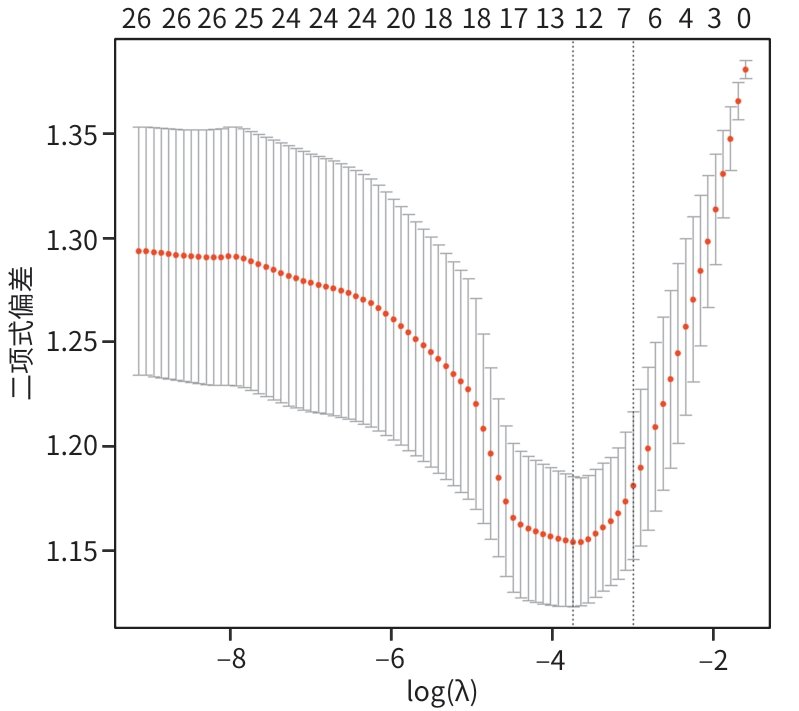
目的 探讨肝硬化患者发生失代偿的独立危险因素,构建基于列线图的风险评估模型,并与终末期肝病模型(MELD)、MELD-Na及MELD 3.0评分系统进行比较,评估其风险评估效能及临床价值。 方法 回顾性纳入2020年1月—2025年5月于山西医科大学第一医院就诊的514例肝硬化患者为研究对象,收集人口学资料、实验室指标等数据。按照是否失代偿分为代偿组(n=275)和失代偿组(n=239)。计量资料两组间比较采用Mann-Whitney U检验,计数资料两组间比较采用χ2检验。通过最小绝对收缩与选择算子回归筛选变量,采用多因素Logistic回归分析确定肝硬化失代偿的独立影响因素,并构建列线图模型。分别采用受试者操作特征曲线、校准曲线和临床决策曲线,从区分度、校准度和临床净获益3个维度评估模型性能。 结果 多因素Logistic回归分析结果显示,低血红蛋白[比值比(OR)=0.984,95%置信区间(CI):0.969~0.999]、低淋巴细胞(OR=0.564,95%CI:0.383~0.830)、国际标准化比值(INR)(OR=3.131,95%CI:1.242~7.891)及低血清钠(OR=0.922,95%CI:0.872~0.975)是肝硬化患者发生失代偿事件的独立影响因素(P值均<0.05)。构建评估模型方程式:Logit(P)=截距值-0.016×血红蛋白-0.573×淋巴细胞+1.141×INR-0.081×血清钠。根据其构建的列线图风险评估模型展现出良好的区分度[受试者操作特征曲线下面积(AUC)=0.787,特异度77.8%,灵敏度67.4%],其预测效能显著高于MELD评分(AUC=0.718)、MELD-Na评分(AUC=0.719)和MELD3.0评分(AUC=0.725)。校准曲线显示,模型评估风险概率与实际发生情况具有良好的一致性。临床决策曲线分析表明,在广泛的风险阈值范围内,该模型较MELD系列评分能提供更高的临床净获益。 结论 本研究成功构建并验证了一个包含血红蛋白、INR、淋巴细胞和血清钠的列线图风险评估模型。该模型具有良好的临床实用性,有助于临床早期识别肝硬化失代偿高危患者并优化干预策略。 Abstract:Objective To investigate the independent risk factors for decompensation in patients with liver cirrhosis, to construct a nomogram-based risk assessment model, and to assess its risk assessment performance and clinical value by comparing it with Model for End-Stage Liver Disease (MELD), MELD combined with serum sodium concentration (MELD-Na), and MELD 3.0 scoring system. Methods A retrospective analysis was performed for 514 patients with liver cirrhosis who attended The First Hospital of Shanxi Medical University from January 2020 to May 2025, and related data were collected, including demographic data and laboratory markers. According to the presence or absence of decompensation, the patients were divided into compensation group with 275 patients and decompensation group with 239 patients. The Mann-Whitney U test was used for comparison of continuous data between two groups, and the chi-square test was used for comparison of categorical data between two groups. The least absolute shrinkage and selection operator regression analysis was used for screening of variables, and the multivariate logistic regression analysis was used to identify independent risk factors for decompensated liver cirrhosis and construct a nomogram model. The receiver operating characteristic (ROC) curve, calibration curve, and decision curve analysis were used to assess the discriminatory ability, calibration, and net clinical benefit of the model. Results The multivariate logistic regression analysis showed that low hemoglobin (odds ratio [OR]=0.984, 95% confidence interval [CI]: 0.969 — 0.999, P<0.05), low lymphocytes (OR=0.564, 95%CI: 0.383 — 0.830, P<0.05), high international normalized ratio (OR=3.131, 95%CI: 1.242 — 7.891, P<0.05), and low serum sodium (OR=0.922, 95%CI: 0.872 — 0.975, P<0.05) were independent risk factors for decompensation events in patients with liver cirrhosis. Construct the prediction model equation: Logit(P)=intercept value-0.016×hemoglobin-0.573×lymphocytes+1.141×INR-0.081×serum sodium. The nomogram constructed based on these factors had a good discriminatory ability, with an area under the ROC curve (AUC) of 0.787, a specificity of 77.8%, and a sensitivity of 67.4%, and it had significantly better predictive performance than MELD score (AUC=0.718), MELD-Na score (AUC=0.719), and MELD 3.0 score (AUC=0.725). The calibration curve showed good consistency between the probability of risk assessed by the model and the observed probability. The decision curve analysis showed that compared with the MELD-based scores, this model provided higher net clinical benefit across a wide range of risk thresholds. Conclusion This study successfully constructed and validated a nomogram risk assessment model incorporating hemoglobin, international normalized ratio, lymphocytes, and serum sodium. This model has good clinical practicability and can help to achieve early identification of high-risk patients with decompensated liver cirrhosis and optimize intervention strategies in clinical practice. -
Key words:
- Liver Cirrhosis /
- Risk Factors /
- Model for End-Stage Liver Disease /
- Nomogram /
-
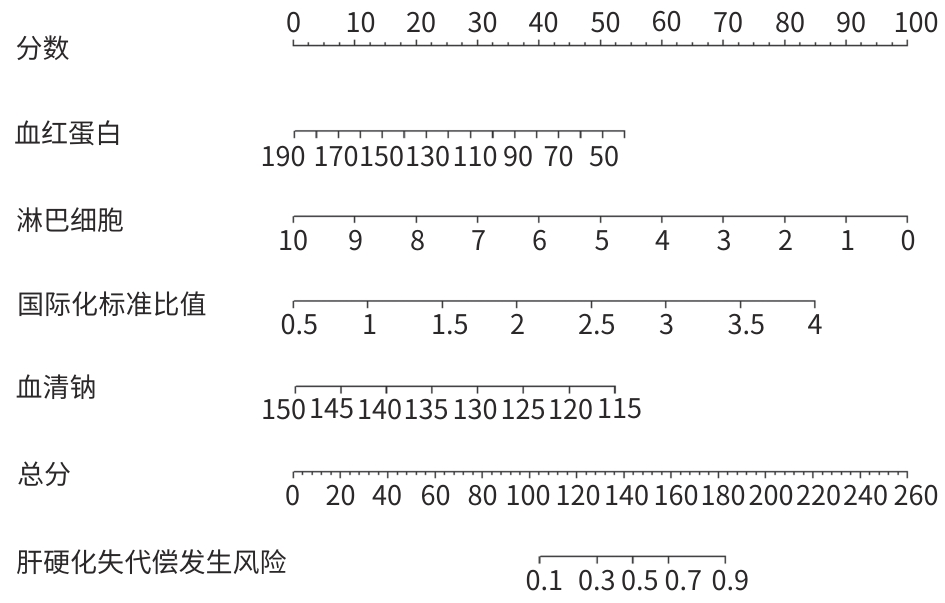
图 3 肝硬化失代偿风险的列线图
Figure 3. Nomogram for the risk of hepatic decompensation in patients with cirrhosis
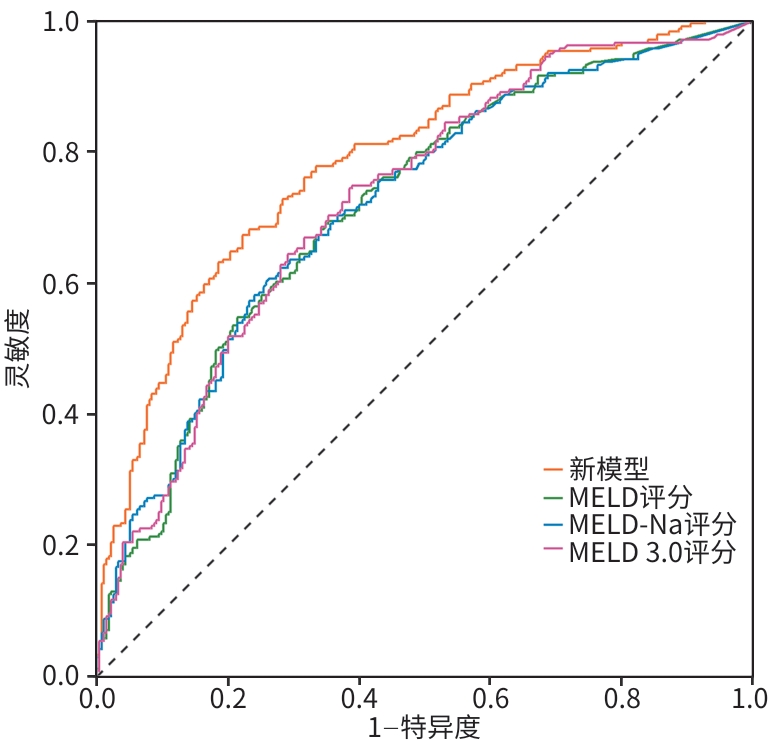
注: MELD,终末期肝病模型。
图 4 肝硬化失代偿风险评估模型的受试者操作特征曲线
Figure 4. ROC curves of the assessment model of hepatic decompensation risk in cirrhotic patients
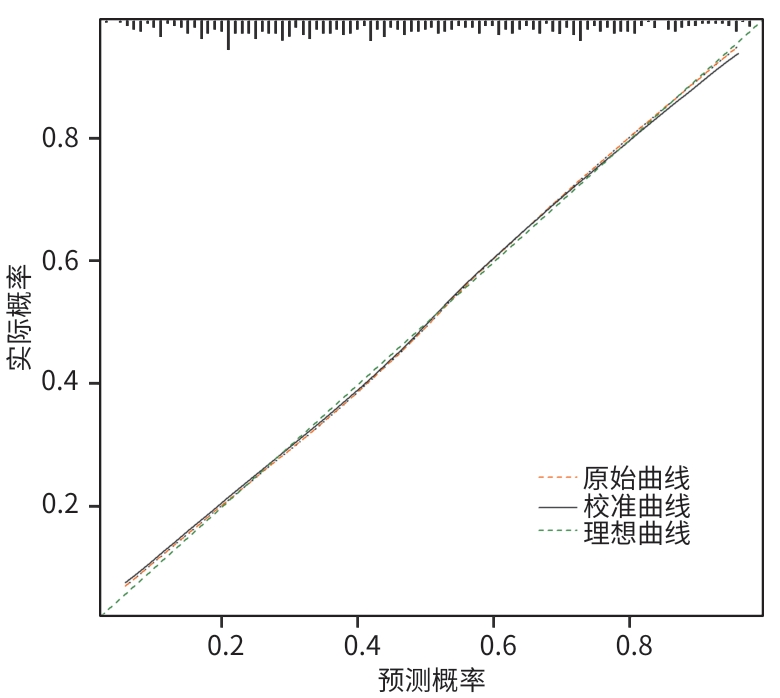
图 5 肝硬化失代偿风险评估模型的校准曲线
Figure 5. Calibration plot of the assessment model for hepatic decompensation risk in patients with cirrhosis
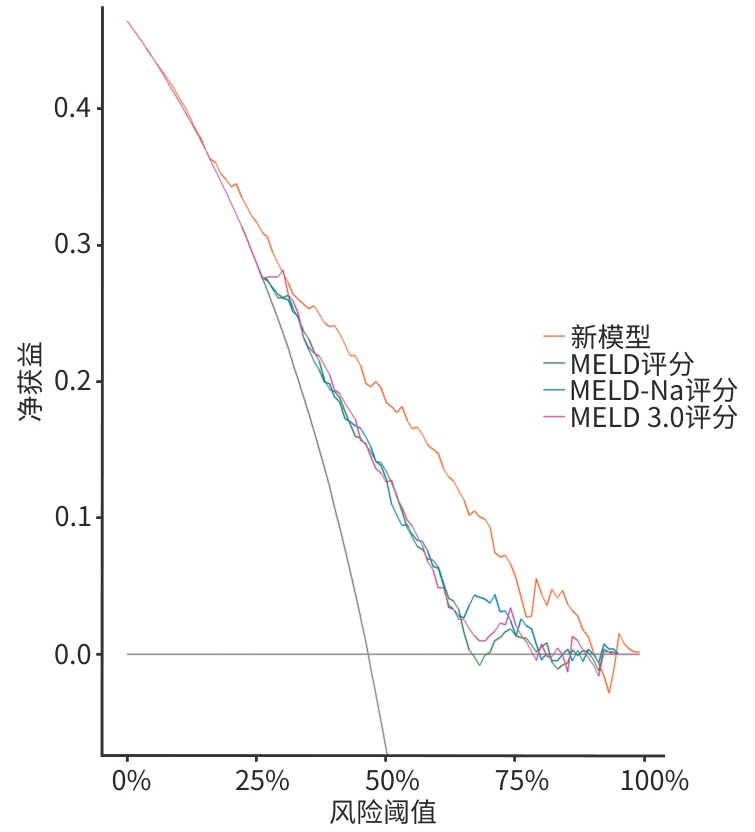
注: MELD,终末期肝病模型。
图 6 肝硬化失代偿风险的决策曲线分析
Figure 6. Decision curve analysis for hepatic decompensation risk in patients with cirrhosis
表 1 不同失代偿状态肝硬化患者的人口学基线特征
Table 1. Demographic and baseline characteristics of cirrhotic patients by decompensation status
变量 总人数(n=514) 代偿组(n=275) 失代偿组(n=239) 统计值 P值 年龄(岁) 58.00(51.00~64.00) 58.00(51.00~65.00) 57.00(49.00~64.00) Ζ=-1.820 0.069 性别[例(%)] χ2=4.629 0.031 男 320(62.3) 183(66.5) 137(57.3) 女 194(37.7) 92(33.5) 102(42.7) 肝病家族史[例(%)] χ2=4.040 0.044 无 479(93.2) 262(95.3) 217(90.8) 有 35(6.8) 13(4.7) 22(9.2) 婚姻状况[例(%)] χ2=0.590 0.442 有配偶 496(96.5) 267(97.1) 229(95.8) 无配偶 18(3.5) 8(2.9) 10(4.2) 吸烟状况[例(%)] χ2=6.985 0.030 不吸烟 333(64.8) 164(59.6) 169(70.7) 戒烟 39(7.6) 23(8.4) 16(6.7) 吸烟 142(27.6) 88(32.0) 54(22.6) 饮酒状况[例(%)] χ2=1.395 0.498 不饮酒 378(73.5) 197(71.6) 181(75.7) 戒酒 55(10.7) 30(10.9) 25(10.5) 饮酒 81(15.8) 48(17.5) 33(13.8) 病因[例(%)] χ2=4.020 0.045 病毒性 312(60.7) 178(64.7) 134(56.1) 非病毒性 202(39.3) 97(35.3) 105(43.9)  下载: 导出CSV
表 2 不同失代偿状态肝硬化患者的基线实验室检查结果
Table 2. Baseline laboratory findings of cirrhotic patients by decompensation status
变量 总人数(n=514) 代偿组(n=275) 失代偿组(n=239) Z值 P值 BMI 23.78(21.35~25.95) 23.95(21.61~26.30) 23.62(20.97~25.71) -1.564 0.118 白细胞(× 4.10(2.70~6.10) 4.70(3.40~6.80) 3.20(2.20~5.10) -6.028 <0.001 红细胞(× 3.94(3.33~4.52) 4.23(3.70~4.75) 3.57(2.91~4.13) -8.861 <0.001 血红蛋白(g/L) 123.00(102.00~142.25) 133.00(117.00~150.00) 108.00(90.00~130.00) -9.102 <0.001 红细胞压积(%) 37.10(31.00~42.95) 40.10(35.50~45.10) 32.60(28.20~38.80) -9.094 <0.001 血小板(× 99.00(53.00~167.50) 132.00(72.00~185.00) 66.00(45.00~121.00) -7.463 <0.001 淋巴细胞(× 0.94(0.60~1.45) 1.23(0.80~1.72) 0.71(0.50~1.05) -8.237 <0.001 单核细胞(× 0.35(0.22~0.52) 0.40(0.30~0.57) 0.30(0.20~0.49) -4.854 <0.001 中性粒细胞(× 2.33(1.48~3.84) 2.64(1.80~4.30) 1.90(1.20~3.33) -4.555 <0.001 嗜酸性粒细胞(× 0.09(0.03~0.13) 0.10(0.05~0.18) 0.06(0.02~0.10) -5.150 <0.001 嗜碱性粒细胞(× 0.01(0.00~0.03) 0.01(0.00~0.03) 0.01(0.00~0.02) -3.382 <0.001 总蛋白(g/L) 63.40(57.88~68.23) 65.10(59.90~69.80) 60.40(56.30~66.30) -5.404 <0.001 白蛋白(g/L) 35.15(30.20~38.73) 37.10(32.70~40.20) 32.10(28.70~36.30) -7.575 <0.001 总胆红素(μmol/L) 23.05(15.48~51.78) 19.00(13.50~31.60) 34.80(19.30~72.10) 6.676 <0.001 直接胆红素(μmol/L) 6.30(3.70~19.93) 4.80(3.10~9.80) 10.80(4.90~33.20) 6.690 <0.001 间接胆红素(μmol/L) 17.00(11.00~30.23) 13.90(10.20~22.10) 21.80(13.50~38.60) 5.885 <0.001 尿素(mmol/L) 4.91(3.81~6.32) 4.89(3.86~6.20) 4.92(3.75~6.45) 0.043 0.965 肌酐(μmol/L) 61.60(51.58~72.00) 63.00(53.00~73.00) 61.00(49.00~70.30) -2.239 0.025 血清氯(mmol/L) 105.45(103.10~108.20) 105.40(103.10~108.00) 105.70(103.10~108.70) 0.434 0.664 血清钠(mmol/L) 140.00(137.00~142.00) 140.00(138.00~142.00) 139.00(136.00~141.00) -4.994 <0.001 血清钙(mmol/L) 2.17(2.07~2.25) 2.20(2.10~2.28) 2.12(2.02~2.22) -5.473 <0.001 无机磷(mmol/L) 1.06(0.87~1.22) 1.09(0.89~1.23) 1.05(0.87~1.21) -0.848 0.397 血清钾(mmol/L) 3.78(3.52~4.09) 3.80(3.52~4.10) 3.76(3.51~4.07) -0.991 0.322 尿酸(μmol/L) 287.37(225.00~362.29) 299.00(239.00~370.13) 271.00(218.00~348.00) -2.868 0.004 ALT(U/L) 30.50(19.75~53.00) 32.00(20.00~53.00) 30.00(19.00~53.00) -0.457 0.648 AST(U/L) 38.00(27.00~64.00) 36.00(25.00~57.00) 43.00(29.00~73.00) 2.585 0.010 GGT(U/L) 63.00(30.00~135.25) 63.00(31.00~123.00) 64.00(28.00~143.00) 0.185 0.853 INR 1.20(1.07~1.39) 1.13(1.03~1.25) 1.30(1.15~1.60) 8.324 <0.001 ALP(U/L) 110.50(78.00~170.00) 104.00(76.00~145.00) 118.00(80.00~197.00) 2.262 0.024 MELD评分(分) 10.19(7.90~14.47) 8.85(7.29~11.48) 12.78(9.27~16.61) 8.518 <0.001 MELD-Na评分(分) 10.47(8.02~15.17) 9.02(7.40~12.00) 13.13(9.47~18.46) 8.575 <0.001 MELD 3.0评分(分) 10.58(8.11~16.30) 8.98(7.33~12.77) 14.00(9.74~18.86) 8.806 <0.001 注:BMI,体重指数;ALT,丙氨酸氨基转移酶;AST,天冬氨酸氨基转移酶;GGT,γ-谷氨酰转移酶;INR,国际标准化比值;ALP,碱性磷酸酶;MELD,终末期肝病模型。
下载: 导出CSV
表 3 多因素Logistic回归分析
Table 3. Multivariate Logistic regression analysis
指标 β值 SE Wald P值 OR 95%CI 血红蛋白 -0.016 0.008 4.224 0.040 0.984 0.969~0.999 淋巴细胞 -0.573 0.198 8.414 0.004 0.564 0.383~0.830 INR 1.141 0.472 5.854 0.016 3.131 1.242~7.891 血清钠 -0.081 0.028 8.155 0.004 0.922 0.872~0.975 注:INR,国际标准化比值;OR,比值比;95%CI,95%置信区间。
下载: 导出CSV
-
[1] DAI EH, GUO XR, WANG JT, et al. Investigate of the etiology and prevention status of liver cirrhosis[J]. Natl Med J China, 2023, 103( 12): 913- 919. DOI: 10.3760/cma.j.cn112137-20221017-02164.戴二黑, 郭心如, 王继涛, 等. 肝硬化的病因及防治现状调查[J]. 中华医学杂志, 2023, 103( 12): 913- 919. DOI: 10.3760/cma.j.cn112137-20221017-02164. [2] TAPPER EB, PARIKH ND. Diagnosis and management of cirrhosis and its complications: A review[J]. JAMA, 2023, 329( 18): 1589- 1602. DOI: 10.1001/jama.2023.5997. [3] TAPPER EB, KANWAL F, ASRANI SK, et al. Patient-reported outcomes in cirrhosis: A scoping review of the literature[J]. Hepatology, 2018, 67( 6): 2375- 2383. DOI: 10.1002/hep.29756. [4] DENG MJ, CAI JR, SHI PM, et al. Pathogenesis and treatment of hepatic encephalopathy: Research progress[J]. Acad J Nav Med Univ, 2025, 46( 6): 784- 789. DOI: 10.16781/j.CN31-218T/R.20240719.邓明杰, 蔡加荣, 时培美, 等. 肝性脑病发病机制及治疗研究进展[J]. 海军军医大学学报, 2025, 46( 6): 784- 789. DOI: 10.16781/j.CN31-218T/R.20240719. [5] XU HX, WANG P, ZHENG YR, et al. Predictive value of MELD 3.0 scores for the prognosis of patients with decompensated cirrhosis[J]. J Nanjing Med Univ Nat Sci, 2025, 45( 8): 1148- 1158. DOI: 10.7655/NYDXBNSN241307.徐鹤翔, 王鹏, 郑袁如, 等. MELD 3.0评分对肝硬化失代偿期患者预后的评估价值[J]. 南京医科大学学报(自然科学版), 2025, 45( 8): 1148- 1158. DOI: 10.7655/NYDXBNSN241307. [6] ZHONG ZW, ABASSA KK, CHEN R, et al. Prognostic value of MELD3.0 based model for survival outcomes in alcoholic cirrhosis patients[J]. J Sun Yat Sen Univ Med Sci, 2025, 46(2): 318-327. DOI: 10.13471/j.cnki.j.sun.yat-sen.univ(med.sci).2025.0216. [7] YANG K, HOU DC, DUAN SX, et al. Predictive values of PNI, LMR and MELD for early lung infection after liver transplantation[J]. Tianjin Med J, 2024, 52( 10): 1041- 1045. DOI: 10.11958/20240184.杨凯, 侯丁聪, 段少先, 等. PNI、LMR、MELD对肝移植术后早期肺部感染的预测价值[J]. 天津医药, 2024, 52( 10): 1041- 1045. DOI: 10.11958/20240184. [8] CHEN YT, XU FF, WANG M, et al. Comparative study of the model for end-stage liver disease and MELD-Na scores in evaluating the short-term prognosis of liver transplantation in patients with liver failure[J/OL]. Chin Arch Gen Surg Electron Ed, 2020, 14( 3): 195- 199. DOI: 10.3877/cma.j.issn.1674-0793.2020.03.007.陈永泰, 许蜂蜂, 王明, 等. 终末期肝病模型评分及MELD-Na评分评估肝衰竭肝移植短期预后的对比观察[J/OL]. 中华普通外科学文献(电子版), 2020, 14( 3): 195- 199. DOI: 10.3877/cma.j.issn.1674-0793.2020.03.007. [9] Chinese Society of Hepatology, Chinese Medical Association. Chinese guidelines for clinical diagnosis, treatment, and management of cirrhosis(2025)[J]. Chin J Hepatol, 2025, 33( 10): 958- 976. DOI: 10.3760/cma.j.cn501113-20250728-00298.中华医学会肝病学分会. 肝硬化临床诊治管理指南(2025版)[J]. 中华肝脏病杂志, 2025, 33( 10): 958- 976. DOI: 10.3760/cma.j.cn501113-20250728-00298. [10] GUO BC, LI YH, CHEN R, et al. Value of MELD 3.0, MELD, and MELD-Na scores in assessing the short-term prognosis of patients with acute-on-chronic liver failure: A comparative study[J]. J Clin Hepatol, 2023, 39( 11): 2635- 2642. DOI: 10.3969/j.issn.1001-5256.2023.11.018.郭北辰, 李雨韩, 陈蕊, 等. MELD 3.0、MELD和MELD-Na评分对慢加急性肝衰竭患者短期预后的评估价值[J]. 临床肝胆病杂志, 2023, 39( 11): 2635- 2642. DOI: 10.3969/j.issn.1001-5256.2023.11.018. [11] HUANG DQ, TERRAULT NA, TACKE F, et al. Global epidemiology of cirrhosis: Aetiology, trends and predictions[J]. Nat Rev Gastroenterol Hepatol, 2023, 20( 6): 388- 398. DOI: 10.1038/s41575-023-00759-2. [12] JALAN R, D’AMICO G, TREBICKA J, et al. New clinical and pathophysiological perspectives defining the trajectory of cirrhosis[J]. J Hepatol, 2021, 75( Suppl 1): S14- S26. DOI: 10.1016/j.jhep.2021.01.018. [13] LISMAN T, CALDWELL SH, INTAGLIATA NM. Haemostatic alterations and management of haemostasis in patients with cirrhosis[J]. J Hepatol, 2022, 76( 6): 1291- 1305. DOI: 10.1016/j.jhep.2021.11.004. [14] LI X, LI MH, TU HM, et al. Analysis of risk factors for rebleeding after endoscopic treatment of esophagogastric variceal bleeding[J]. J Vasc Endovasc Surg, 2023, 9( 3): 359- 362. DOI: 10.19418/j.cnki.issn2096-0646.2023.03.21.李霞, 李敏华, 屠惠明, 等. 内镜下治疗食管胃底静脉曲张出血后再出血的危险因素分析[J]. 血管与腔内血管外科杂志, 2023, 9( 3): 359- 362. DOI: 10.19418/j.cnki.issn2096-0646.2023.03.21. [15] ZHAO YC, XU J, CHEN SX, et al. Association between microRNA-183-5p levels and rebleeding after TIPS in cirrhosis patients with esophageal and gastric variceal bleeding[J]. China J Mod Med, 2022, 32( 16): 62- 68. DOI: 10.3969/j.issn.1005-8982.2022.16.011.赵永昌, 徐菁, 陈士新, 等. 肝硬化食管胃底静脉曲张破裂出血患者miR-183-5p水平与经颈静脉肝内门腔静脉分流术后再出血的关系[J]. 中国现代医学杂志, 2022, 32( 16): 62- 68. DOI: 10.3969/j.issn.1005-8982.2022.16.011. [16] WU J, YIN F, LUO GH, et al. Association of hyponatremia with degree of liver injury and complications in patients with decompensated liver cirrhosis[J]. J Clin Hepatol, 2017, 33( 2): 277- 280. DOI: 10.3969/j.issn.1001-5256.2017.02.014.武健, 尹芳, 罗贯虹, 等. 失代偿期肝硬化患者低钠血症与肝损伤程度及并发症的关系[J]. 临床肝胆病杂志, 2017, 33( 2): 277- 280. DOI: 10.3969/j.issn.1001-5256.2017.02.014. [17] MA Y, WANG XZ, YAN GW, et al. Effect of hyponatremia on prognosis of patients with decompensated hepatitis B cirrhosis[J]. Med Recapitul, 2021, 27( 4): 796- 803. DOI: 10.3969/j.issn.1006-2084.2021.04.032.马燕, 王晓忠, 延国威, 等. 低钠血症对乙肝肝硬化失代偿期患者预后的影响[J]. 医学综述, 2021, 27( 4): 796- 803. DOI: 10.3969/j.issn.1006-2084.2021.04.032. [18] YUAN XY, HUANG YQ, JIANG M. Influence of hyponatremia on the condition and prognosis of patients with liver cirrhosis[J]. J China Med Univ, 2019, 48( 11): 1003- 1006. DOI: 10.12007/j.issn.0258-4646.2019.11.010.袁晓艳, 黄颖秋, 姜敏. 低钠血症对肝硬化患者病情和预后的影响[J]. 中国医科大学学报, 2019, 48( 11): 1003- 1006. DOI: 10.12007/j.issn.0258-4646.2019.11.010. [19] ZHOU J. Relationship between hyponatremia level, complications and clinical prognosis in patients with decompensated cirrhosis[J]. Gansu Sci Technol, 2019, 35( 8): 149- 150. DOI: 10.3969/j.issn.1000-0952.2019.08.050.周渐. 肝硬化失代偿期患者低钠血症水平与并发症及临床预后关系[J]. 甘肃科技, 2019, 35( 8): 149- 150. DOI: 10.3969/j.issn.1000-0952.2019.08.050. [20] LAI M, WANG X, YAO QW, et al. Predictive value of the initial MELD score and its derivative scores for early survival rate after liver transplantation in patients with liver failure[J]. Organ Transplant, 2022, 13( 4): 489- 494. DOI: 10.3969/j.issn.1674-7445.2022.04.012.赖曼, 王鑫, 姚勤伟, 等. 术后首次MELD评分及其衍生评分对肝衰竭患者肝移植术后早期生存率的预测价值[J]. 器官移植, 2022, 13( 4): 489- 494. DOI: 10.3969/j.issn.1674-7445.2022.04.012. [21] Chinese Society of Hepatology, Chinese Medical Association. Chinese guidelines on the management of liver cirrhosis[J]. J Clin Hepatol, 2019, 35( 11): 2408- 2425. DOI: 10.3969/j.issn.1001-5256.2019.11.006.中华医学会肝病学分会. 肝硬化诊治指南[J]. 临床肝胆病杂志, 2019, 35( 11): 2408- 2425. DOI: 10.3969/j.issn.1001-5256.2019.11.006. [22] YANG ZH, CHEN MJ, ZHANG MX, et al. Research progress of multi-dimensional liver function evaluation in predicting liver cirrhosis compensation[J]. Clin J Med Offic, 2026, 54( 2): 111- 114, 120.杨志慧, 陈美娟, 张濛销, 等. 多维度肝功能评估预测肝硬化再代偿研究进展[J]. 临床军医杂志, 2026, 54( 2): 111- 114, 120. [23] FAN Q, WU GB, ZHAO JB, et al. Research progress in pathophysiological and molecular mechanism changes during decompensated phase of portal hypertension in liver cirrhosis[J]. J Shanghai Jiao Tong Univ Med Sci, 2024, 44( 3): 379- 384. DOI: 10.3969/j.issn.1674-8115.2024.03.011.樊强, 吴广博, 赵劲博, 等. 肝硬化失代偿期门静脉高压症病理生理及分子机制改变的研究进展[J]. 上海交通大学学报(医学版), 2024, 44( 3): 379- 384. DOI: 10.3969/j.issn.1674-8115.2024.03.011. [24] REN HT, LI H, DENG GH, et al. Severe Anemia is associated with increased short-term and long-term mortality in patients hospitalized with cirrhosis[J]. Ann Hepatol, 2023, 28( 6): 101147. DOI: 10.1016/j.aohep.2023.101147. [25] LAU LHS, SUNG JJY. Treatment of upper gastrointestinal bleeding in 2020: New techniques and outcomes[J]. Dig Endosc, 2021, 33( 1): 83- 94. DOI: 10.1111/den.13674. [26] NAN YM, LI JZ. Liver cirrhosis and infections: The state of the disease[J]. J Pract Hepatol, 2022, 25( 5): 609- 611. DOI: 10.3969/j.issn.1672-5069.2022.05.001.南月敏, 李佳峥. 肝硬化与感染[J]. 实用肝脏病杂志, 2022, 25( 5): 609- 611. DOI: 10.3969/j.issn.1672-5069.2022.05.001. [27] CHEN JH, WAN YL, WANG LP. Nomogram model construction for bacterial infection complicated with esophageal variceal hemorrhage in cirrhotic patients based on LASSO regression[J]. Anhui Med Pharm J, 2025, 29( 12): 2431- 2438. DOI: 10.3969/j.issn.1009-6469.2025.12.021.陈家辉, 万雨林, 汪莉萍. 基于LASSO回归的肝硬化病人食管静脉曲张破裂出血后并发细菌感染的预测模型建立[J]. 安徽医药, 2025, 29( 12): 2431- 2438. DOI: 10.3969/j.issn.1009-6469.2025.12.021. -

 本文二维码
本文二维码
计量
- 文章访问数: 408
- HTML全文浏览量: 182
- PDF下载量: 105
- 被引次数: 0