PDF下载 ( 1194 KB)

肠道菌群-Toll样受体轴与代谢相关脂肪性肝病的关系
DOI: 10.12449/JCH260625
利益冲突声明:本文不存在任何利益冲突。
作者贡献声明:孙媛媛负责撰写论文;张存正负责论文设计;徐静远、周春晓负责指导文章撰写并最后定稿。
Association between the gut microbiota-Toll-like receptor axis and metabolic associated fatty liver disease
-
摘要: 代谢相关脂肪性肝病(MAFLD)的发病与肠道菌群紊乱密切相关。菌群失调可导致细菌衍生物(如脂多糖)易位,通过激活Toll样受体(TLR)及其下游信号通路,驱动肝脏炎症反应与代谢失衡。本文系统综述了肠道菌群-TLR在MAFLD中的作用机制,重点阐述了TLR2、TLR4等关键受体,以及TLR5、TLR7、TLR9等较少受关注成员的功能;总结了TLR激活后的下游信号事件,包括经典核因子κB、促分裂原活化的蛋白激酶通路,以及在MAFLD病理机制中日益受到关注的Janus激酶-信号转导与转录激活因子和磷脂酰肌醇3激酶-蛋白激酶B通路;最后归纳了以肠道菌群为靶点、通过调控肠道菌群-TLR信号轴治疗MAFLD的潜在干预策略,为临床防治提供了新思路。Abstract: The pathogenesis of metabolic associated fatty liver disease (MAFLD) is closely associated with gut microbiota dysbiosis. Dysbiosis can lead to translocation of bacterial derivatives (such as lipopolysaccharide), which drives hepatic inflammatory response and metabolic imbalance by activating Toll-like receptors (TLR) and their downstream signaling pathways. This article systematically reviews the mechanism of action of the gut microbiota-TLR axis in MAFLD, and elaborates on the function of the key receptors such as TLR2 and TLR4 and the lesser-studied members (TLR5, TLR7, and TLR9). This article also summarizes the downstream signaling events after TLR activation, including the canonical NF-κB and MAPK pathways, as well as the role of the JAK-STAT and PI3K-Akt pathways in the pathological mechanism of MAFLD. Finally, this article reviews the potential intervention strategies for MAFLD by targeting gut microbiota and regulating the gut microbiota-TLR signaling axis, in order to provide new ideas for clinical prevention and treatment.
-
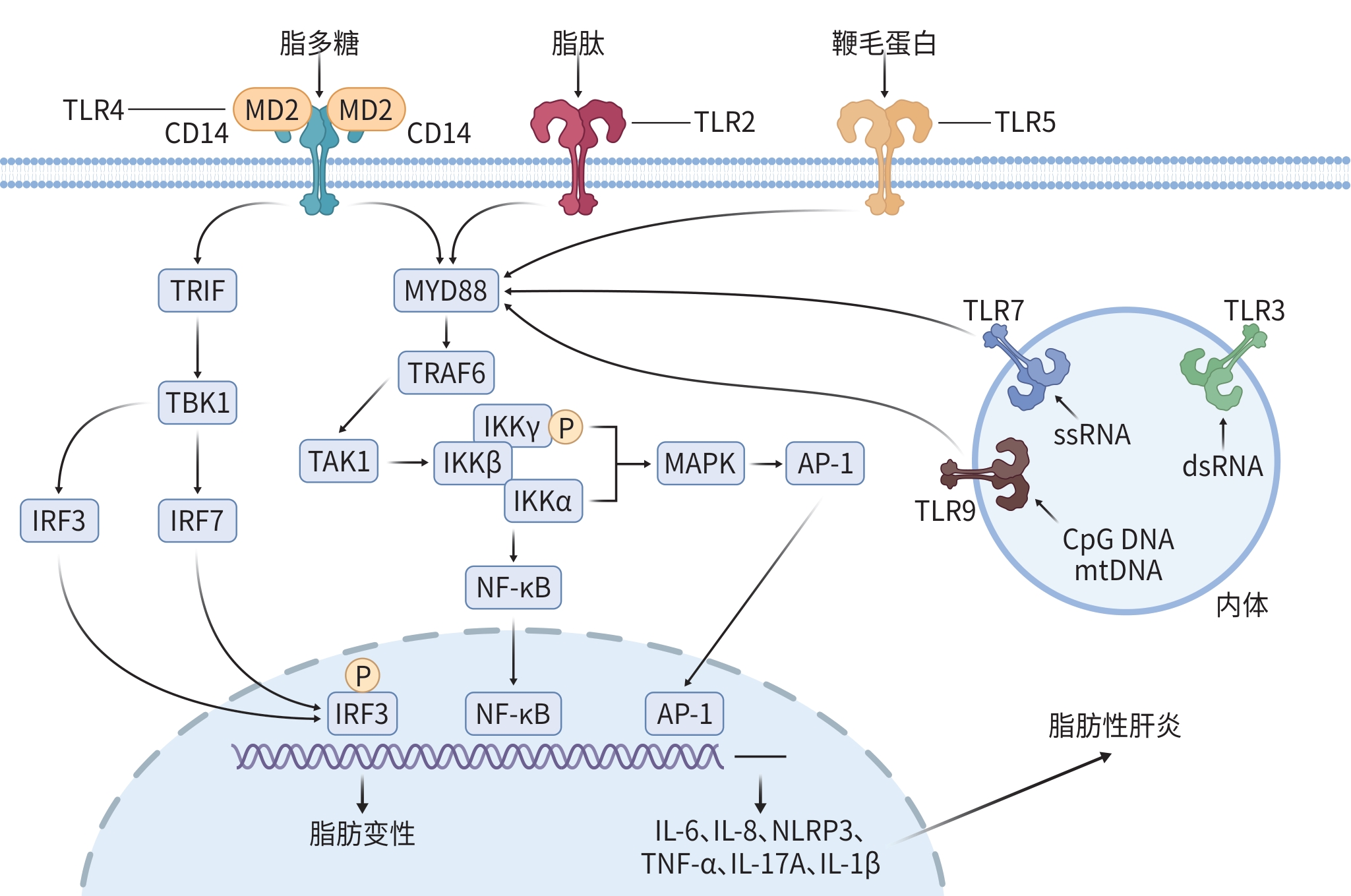
注: MD2,髓样分化蛋白2;CD14,白细胞分化抗原14;TRIF,含有Toll/IL-1受体结构域的诱导干扰素β的衔接蛋白;TBK1,TANK结合激酶1;IRF3,干扰素调节因子3;IRF7,干扰素调节因子7;MYD88,髓系分化初级反应蛋白质88;TRAF6,肿瘤坏死因子受体相关因子6;TAK1,TGF-β激活激酶1;IKKα,核因子κB激酶亚基α抑制剂;IKKβ,核因子κB激酶亚基β抑制剂;IKKγ,核因子κB激酶亚基γ抑制剂;NF-κB,核因子κB;MAPK,促分裂原活化的蛋白激酶;AP-1,激活蛋白1;dsRNA,双链RNA;ssRNA,单链RNA;mtDNA,线粒体DNA;CpG DNA,胞嘧啶-磷酸-鸟嘌呤DNA;IL-6,白细胞介素6;IL-8,白细胞介素8;NLRP3,NOD样受体热蛋白结构域相关蛋白3;TNF-α,肿瘤坏死因子α;IL-17A,白细胞介素17A;IL-1β,白细胞介素1β;TLR,Toll样受体。
图 1 TLR活化后引起的下游通路
Figure 1. Downstream signaling pathways activated by TLR
-
[1] MIAO L, TARGHER G, BYRNE CD, et al. Current status and future trends of the global burden of MASLD[J]. Trends Endocrinol Metab, 2024, 35( 8): 697- 707. DOI: 10.1016/j.tem.2024.02.007. [2] ZHOU M, BO T, FAN XD, et al. Metabolic dysfunction-associated fatty liver disease: A central hub in systemic metabolic dysregulation[J]. J Clin Hepatol, 2025, 41( 9): 1725- 1728. DOI: 10.12449/JCH250902.周蒙, 薄涛, 范修德, 等. 代谢相关脂肪性肝病: 全身代谢性紊乱的核心枢纽之一[J]. 临床肝胆病杂志, 2025, 41( 9): 1725- 1728. DOI: 10.12449/JCH250902. [3] YOUNOSSI Z, ANSTEE QM, MARIETTI M, et al. Global burden of NAFLD and NASH: Trends, predictions, risk factors and prevention[J]. Nat Rev Gastroenterol Hepatol, 2018, 15( 1): 11- 20. DOI: 10.1038/nrgastro.2017.109. [4] HUANG WS. The prevalence of metabolic dysfunction-associated fatty liver disease in Asia[J]. J Clin Hepatol, 2025, 41( 9): 1721- 1724. DOI: 10.12449/JCH250901.黄炜燊. 亚洲地区代谢相关脂肪性肝病流行情况[J]. 临床肝胆病杂志, 2025, 41( 9): 1721- 1724. DOI: 10.12449/JCH250901. [5] Digestive System Diseases Professional Committee of Chinese Association of Integrative Medicine. Expert consensus on integrated traditional Chinese and western medicine diagnosis and treatment of non-alcoholic fatty liver disease(2025)[J]. Chin J Integr Tradit West Med Dig, 2025, 33( 4): 339- 350. DOI: 10.3969/j.issn.1671-038X.2025.04.01.中国中西医结合学会消化系统疾病专业委员会. 非酒精性脂肪性肝病中西医结合诊疗专家共识(2025年)[J]. 中国中西医结合消化杂志, 2025, 33( 4): 339- 350. DOI: 10.3969/j.issn.1671-038X.2025.04.01. [6] YU LL, GAO FF, LI YX, et al. Role of pattern recognition receptors in the development of MASLD and potential therapeutic applications[J]. Biomed Pharmacother, 2024, 175: 116724. DOI: 10.1016/j.biopha.2024.116724. [7] GHOSH S, WHITLEY CS, HARIBABU B, et al. Regulation of intestinal barrier function by microbial metabolites[J]. Cell Mol Gastroenterol Hepatol, 2021, 11( 5): 1463- 1482. DOI: 10.1016/j.jcmgh.2021.02.007. [8] WEISS GA, HENNET T. Mechanisms and consequences of intestinal dysbiosis[J]. Cell Mol Life Sci, 2017, 74( 16): 2959- 2977. DOI: 10.1007/s00018-017-2509-x. [9] MOSZAK M, SZULIŃSKA M, BOGDAŃSKI P. You are what you eat-the relationship between diet, microbiota, and metabolic disorders-a review[J]. Nutrients, 2020, 12( 4): 1096. DOI: 10.3390/nu12041096. [10] SU X, CHEN SY, LIU JZ, et al. Composition of gut microbiota and non-alcoholic fatty liver disease: A systematic review and meta-analysis[J]. Obes Rev, 2024, 25( 1): e13646. DOI: 10.1111/obr.13646. [11] JASIRWAN COM, MURADI A, HASAN I, et al. Correlation of gut Firmicutes/Bacteroidetes ratio with fibrosis and steatosis stratified by body mass index in patients with non-alcoholic fatty liver disease[J]. Biosci Microbiota Food Health, 2021, 40( 1): 50- 58. DOI: 10.12938/bmfh.2020-046. [12] LAU HC, ZHANG X, YU J. Gut microbiome in metabolic dysfunction-associated steatotic liver disease and associated hepatocellular carcinoma[J]. Nat Rev Gastroenterol Hepatol, 2025, 22( 9): 619- 638. DOI: 10.1038/s41575-025-01089-1. [13] SCHWIMMER JB, JOHNSON JS, ANGELES JE, et al. Microbiome signatures associated with steatohepatitis and moderate to severe fibrosis in children with nonalcoholic fatty liver disease[J]. Gastroenterology, 2019, 157( 4): 1109- 1122. DOI: 10.1053/j.gastro.2019.06.028. [14] YUAN J, CHEN C, CUI JH, et al. Fatty liver disease caused by high-alcohol-producing Klebsiella pneumoniae[J]. Cell Metab, 2019, 30( 6): 1172. DOI: 10.1016/j.cmet.2019.11.006. [15] FITZGERALD KA, KAGAN JC. Toll-like receptors and the control of immunity[J]. Cell, 2020, 180( 6): 1044- 1066. DOI: 10.1016/j.cell.2020.02.041. [16] RAY A, COT M, PUZO G, et al. Bacterial cell wall macroamphiphiles: Pathogen-/ microbe-associated molecular patterns detected by mammalian innate immune system[J]. Biochimie, 2013, 95( 1): 33- 42. DOI: 10.1016/j.biochi.2012.06.007. [17] KIZILTAS S. Toll-like receptors in pathophysiology of liver diseases[J]. World J Hepatol, 2016, 8( 32): 1354- 1369. DOI: 10.4254/wjh.v8.i32.1354. [18] HOU KJ, WU ZX, CHEN XY, et al. Microbiota in health and diseases[J]. Signal Transduct Target Ther, 2022, 7( 1): 135. DOI: 10.1038/s41392-022-00974-4. [19] WIEST R, LAWSON M, GEUKING M. Pathological bacterial translocation in liver cirrhosis[J]. J Hepatol, 2014, 60( 1): 197- 209. DOI: 10.1016/j.jhep.2013.07.044. [20] KUBES P, MEHAL WZ. Sterile inflammation in the liver[J]. Gastroenterology, 2012, 143( 5): 1158- 1172. DOI: 10.1053/j.gastro.2012.09.008. [21] ZHANG YL, WU BB, ZHANG HL, et al. Inhibition of MD2-dependent inflammation attenuates the progression of non-alcoholic fatty liver disease[J]. J Cell Mol Med, 2018, 22( 2): 936- 947. DOI: 10.1111/jcmm.13395. [22] ROY S, SAHA P, BOSE D, et al. Hepatic NLRP3-derived Hsp70 binding to TLR4 mediates MASLD to MASH progression upon inhibition of PP2A by harmful algal bloom toxin microcystin, a second hit[J]. Int J Mol Sci, 2023, 24( 22): 16354. DOI: 10.3390/ijms242216354. [23] MERCADO-GÓMEZ M, GOIKOETXEA-USANDIZAGA N, KERBERT AJC, et al. The lipopolysaccharide-TLR4 axis regulates hepatic glutaminase 1 expression promoting liver ammonia build-up as steatotic liver disease progresses to steatohepatitis[J]. Metabolism, 2024, 158: 155952. DOI: 10.1016/j.metabol.2024.155952. [24] XU R, CAO JW, LV HL, et al. Polyethylene microplastics induced gut microbiota dysbiosis leading to liver injury via the TLR2/NF-κB/NLRP3 pathway in mice[J]. Sci Total Environ, 2024, 917: 170518. DOI: 10.1016/j.scitotenv.2024.170518. [25] ZHANG LT, XIE ZH, YU HM, et al. TLR2 inhibition ameliorates the amplification effect of LPS on lipid accumulation and lipotoxicity in hepatic cells[J]. Ann Transl Med, 2021, 9( 18): 1429. DOI: 10.21037/atm-21-4012. [26] HAN YQ, LING Q, WU L, et al. Akkermansia muciniphila inhibits nonalcoholic steatohepatitis by orchestrating TLR2-activated γδT17 cell and macrophage polarization[J]. Gut Microbes, 2023, 15( 1): 2221485. DOI: 10.1080/19490976.2023.2221485. [27] URUSHIMA H, MATSUBARA T, GU QY, et al. AHCC inhibited hepatic stellate cells activation by regulation of cytoglobin induction via TLR2-SAPK/JNK pathway and collagen production via TLR4-NF-κβ pathway[J]. Am J Physiol Gastrointest Liver Physiol, 2024, 327( 6): G741- G753. DOI: 10.1152/ajpgi.00134.2024. [28] ROH YS, KIM JW, PARK S, et al. Toll-like receptor-7 signaling promotes nonalcoholic steatohepatitis by inhibiting regulatory T cells in mice[J]. Am J Pathol, 2018, 188( 11): 2574- 2588. DOI: 10.1016/j.ajpath.2018.07.011. [29] JEONG SW. Toll-like receptor 9, a possible blocker of non-alcoholic steatohepatitis[J]. Clin Mol Hepatol, 2020, 26( 2): 185- 186. DOI: 10.3350/cmh.2020.0046. [30] ETIENNE-MESMIN L, VIJAY-KUMAR M, GEWIRTZ AT, et al. Hepatocyte Toll-like receptor 5 promotes bacterial clearance and protects mice against high-fat diet-induced liver disease[J]. Cell Mol Gastroenterol Hepatol, 2016, 2( 5): 584- 604. DOI: 10.1016/j.jcmgh.2016.04.007. [31] HAYDEN MS, GHOSH S. NF-κB, the first quarter-century: Remarkable progress and outstanding questions[J]. Genes Dev, 2012, 26( 3): 203- 234. DOI: 10.1101/gad.183434.111. [32] NÓVOA E, SILVA LIMA N DA, GONZALEZ-RELLAN MJ, et al. Mitochondrial antiviral signaling protein enhances MASLD progression through the ERK/TNFα/NFκβ pathway[J]. Hepatology, 2025, 81( 5): 1535- 1552. DOI: 10.1097/HEP.0000000000000930. [33] BAI L, QU WY, CHENG X, et al. Multispecies transcriptomics identifies SIKE as a MAPK repressor that prevents NASH progression[J]. Sci Transl Med, 2024, 16( 734): eade7347. DOI: 10.1126/scitranslmed.ade7347. [34] YE JX, ZHU WW, CUI YQ, et al. Compound J27 alleviates high-fat diet-induced metabolic dysfunction-associated steatotic liver disease by targeting JNK[J]. Int Immunopharmacol, 2025, 154: 114570. DOI: 10.1016/j.intimp.2025.114570. [35] DAS D, BANERJEE A, MUKHERJEE S, et al. Quercetin inhibits NF-kB and JAK/STAT signaling via modulating TLR in thymocytes and splenocytes during MSG-induced immunotoxicity: An in vitro approach[J]. Mol Biol Rep, 2024, 51( 1): 277. DOI: 10.1007/s11033-024-09245-7. [36] ZHU LX, BAKER SS, GILL C, et al. Characterization of gut microbiomes in nonalcoholic steatohepatitis(NASH) patients: A connection between endogenous alcohol and NASH[J]. Hepatology, 2013, 57( 2): 601- 609. DOI: 10.1002/hep.26093. [37] SINGH SB, BRAUN CA, CARROLL-PORTILLO A, et al. Sulfate-reducing bacteria induce pro-inflammatory TNF-α and iNOS via PI3K/Akt pathway in a TLR 2-dependent manner[J]. Microorganisms, 2024, 12( 9): 1833. DOI: 10.3390/microorganisms12091833. [38] WANG J, ZHANG C, XU P, et al. Phosphoinositide 3-kinase/protein kinase B regulates inflammation severity via signaling of Toll-like receptor 4 in severe acute pancreatitis[J]. Mol Med Rep, 2018, 17( 6): 7835- 7844. DOI: 10.3892/mmr.2018.8819. [39] MOHAMAD NOR MH, AYOB N, MOKHTAR NM, et al. The effect of probiotics(MCP® BCMC® strains) on hepatic steatosis, small intestinal mucosal immune function, and intestinal barrier in patients with non-alcoholic fatty liver disease[J]. Nutrients, 2021, 13( 9): 3192. DOI: 10.3390/nu13093192. [40] KAUR H, ALI SA. Probiotics and gut microbiota: Mechanistic insights into gut immune homeostasis through TLR pathway regulation[J]. Food Funct, 2022, 13( 14): 7423- 7447. DOI: 10.1039/d2fo00911k. [41] KAJIKAWA A, MIDORIKAWA E, MASUDA K, et al. Characterization of flagellins isolated from a highly motile strain of Lactobacillus agilis[J]. BMC Microbiol, 2016, 16: 49. DOI: 10.1186/s12866-016-0667-x. [42] BOMHOF MR, PARNELL JA, RAMAY HR, et al. Histological improvement of non-alcoholic steatohepatitis with a prebiotic: A pilot clinical trial[J]. Eur J Nutr, 2019, 58( 4): 1735- 1745. DOI: 10.1007/s00394-018-1721-2. [43] VINDEROLA G, SANDERS ME, SALMINEN S. The concept of postbiotics[J]. Foods, 2022, 11( 8): 1077. DOI: 10.3390/foods11081077. [44] FOGACCI F, GIOVANNINI M, di MICOLI V, et al. Effect of supplementation of a butyrate-based formula in individuals with liver steatosis and metabolic syndrome: A randomized double-blind placebo-controlled clinical trial[J]. Nutrients, 2024, 16( 15): 2454. DOI: 10.3390/nu16152454. [45] MAYORGAS A, DOTTI I, SALAS A. Microbial metabolites, postbiotics, and intestinal epithelial function[J]. Molecular Nutrition Food Res, 2021, 65( 5): 2000188. DOI: 10.1002/mnfr.202000188. [46] PÉREZ-MATUTE P, ÍÑIGUEZ M, DE TORO M, et al. Autologous fecal transplantation from a lean state potentiates caloric restriction effects on body weight and adiposity in obese mice[J]. Sci Rep, 2020, 10( 1): 9388. DOI: 10.1038/s41598-020-64961-x. [47] WANG WW, ZHANG Y, HUANG XB, et al. Fecal microbiota transplantation prevents hepatic encephalopathy in rats with carbon tetrachloride-induced acute hepatic dysfunction[J]. World J Gastroenterol, 2017, 23( 38): 6983- 6994. DOI: 10.3748/wjg.v23.i38.6983. [48] XUE LF, DENG ZL, LUO WH, et al. Effect of fecal microbiota transplantation on non-alcoholic fatty liver disease: A randomized clinical trial[J]. Front Cell Infect Microbiol, 2022, 12: 759306. DOI: 10.3389/fcimb.2022.759306. [49] CHEN N, GENG N, LI J. Mechanisms and clinical practice advances in weight reduction for patients with metabolic associated fatty liver disease[J/CD]. Chin J Liver Dis(Electronic Version), 2025, 17( 3): 10- 16. DOI: 10.3969/j.issn.1674-7380.2025.03.002.陈楠, 耿楠, 李婕. 代谢相关脂肪性肝病患者减重治疗机制与临床实践进展[J/CD]. 中国肝脏病杂志(电子版), 2025, 17( 3): 10- 16. DOI: 10.3969/j.issn.1674-7380.2025.03.002. [50] ZOU CW, CHEN Y, LI HY, et al. Engineered bacteria EcN-MT alleviate liver injury in cadmium-exposed mice via its probiotics characteristics and expressing of metallothionein[J]. Front Pharmacol, 2022, 13: 857869. DOI: 10.3389/fphar.2022.857869. [51] SCHÖLER D, SCHNABL B. The role of the microbiome in liver disease[J]. Curr Opin Gastroenterol, 2024, 40( 3): 134- 142. DOI: 10.1097/MOG.0000000000001013. [52] DUAN Y, LLORENTE C, LANG S, et al. Bacteriophage targeting of gut bacterium attenuates alcoholic liver disease[J]. Nature, 2019, 575( 7783): 505- 511. DOI: 10.1038/s41586-019-1742-x. [53] YI MJ, FASINA OB, LI YJ, et al. Mixture of peanut skin extract, geniposide, and isoquercitrin improves the hepatic lipid accumulation of mice via modification of gut microbiota homeostasis and the TLR4 and AMPK signaling pathways[J]. Int J Mol Sci, 2023, 24( 23): 16684. DOI: 10.3390/ijms242316684. -

 下载:
下载:
 本文二维码
本文二维码
图(1)
计量
- 文章访问数: 368
- HTML全文浏览量: 91
- PDF下载量: 101
- 被引次数: 0