PDF下载 ( 965 KB)

乙型肝炎病毒致肝细胞癌的关键机制及防控策略
DOI: 10.12449/JCH260808
利益冲突声明:本文不存在任何利益冲突。
作者贡献声明:谢璐泽负责查阅文献并撰写论文;席雅璇负责归纳文献并修改论文;曹广文负责指导撰写并修改论文。
Key mechanisms of hepatitis B virus-induced hepatocellular carcinoma and related prevention and control strategies
-
摘要: 乙型肝炎病毒(HBV)慢性感染是肝细胞癌(HCC)的主要原因,其对全球HCC的人群归因分数为57.1%,对中国HCC的人群归因分数为76.1%。阐明HBV致癌的早期分子机制,有助于HCC的精准预防。HBV持续复制、变异、整合及其协同驱动是HBV致癌的主要机制。HBV复制可激活并维持肝脏慢性炎症微环境,为病毒变异累积提供条件;在慢性炎症条件下,炎症因子使载脂蛋白B mRNA编辑酶催化多肽样3B(变异酶)-尿嘧啶-DNA糖基化酶(修复酶)失衡,促进HBV变异和人基因组突变,HBV变异致癌能力增强,炎症微环境可促进变异细胞去分化并获得干性特征;HBV基因组整合可导致端粒酶逆转录酶启动子等“守门人”变异,引发染色体不稳定与表观遗传重编程。HBV复制、变异和整合三大环节在“变异-选择-适应”的进化规律下协同作用,共同推动HCC的发生和发展。HBV高危变异谱、外周血整合片段及端粒酶逆转录酶启动子突变等分子标志物,可指导HCC的抗病毒精准预防、辅助早期筛查与术后复发监测,为完善HCC分层防控策略提供科学依据。Abstract: Chronic hepatitis B virus (HBV) infection is a major cause of hepatocellular carcinoma (HCC), with a population-attributable fraction of 57.1% for HCC globally and 76.1% for HCC in China. Identifying the early molecular mechanisms of HBV-driven hepatocarcinogenesis can facilitate precise HCC prevention. Persistent HBV replication, HBV mutation, HBV integration, and the synergistic interplay among them are the main mechanisms of HBV-driven hepatocarcinogenesis. HBV replication activates and sustains a chronic hepatic inflammatory microenvironment, providing conditions for accumulation of viral mutations; under the conditions of chronic inflammation, inflammatory factors cause the imbalance between apolipoprotein B messenger RNA editing enzyme catalytic polypeptide-like 3B and uracil-DNA glycosylase, which promotes HBV mutations and human genomic mutations and enhances the carcinogenic effect of HBV mutations, and the inflammatory microenvironment can promote dedifferentiation of mutated cells and acquisition of stemness; HBV genome integration can cause “gate-keeper” mutations including telomerase reverse transcriptase (TERT) promoter mutation, thereby triggering chromosomal instability and epigenetic reprogramming. The three events of HBV replication, mutation, and integration work synergistically under the evolutionary principle of “variation-selection-adaptation” and jointly drive the development and progression of HCC. The high-risk HBV mutation profile, circulating HBV integration fragments, and the TERT promoter mutations can be used to guide precision HCC prevention via antiviral prophylaxis and assist in early screening and monitoring of postoperative recurrence, which provides a scientific basis for refining stratified prevention and control strategies against HCC.
-
Key words:
- Hepatitis B Virus /
- Carcinoma, Hepatocellular /
- Pathologic Processes /
- Disease Prevention
-
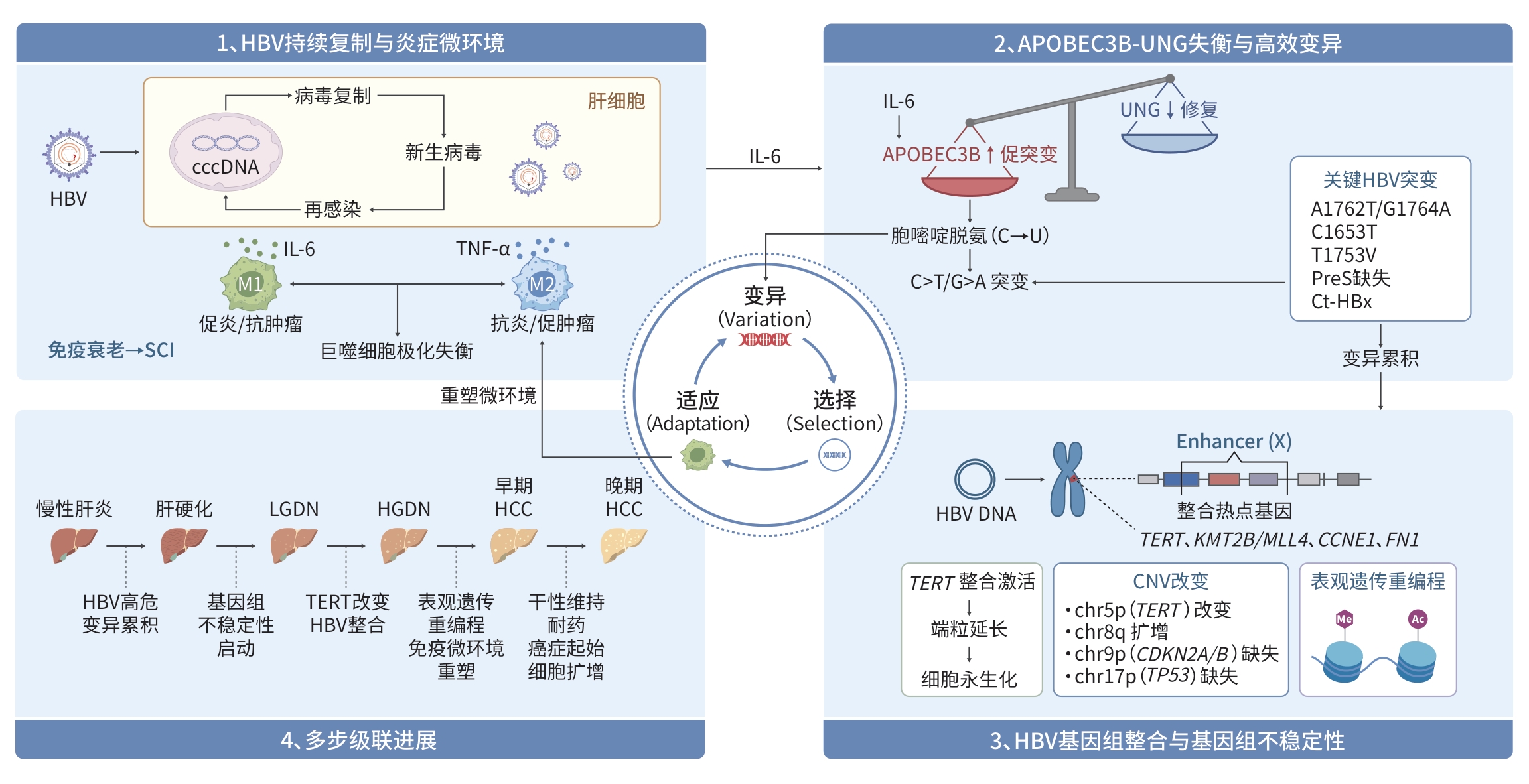
注: HBV,乙型肝炎病毒;cccDNA,共价闭合环状DNA;IL-6,白细胞介素6;TNF-α,肿瘤坏死因子α;SCI,全身低强度慢性炎症;APOBEC3B,载脂蛋白B mRNA编辑酶催化多肽样3B;UNG,尿嘧啶-DNA糖基化酶;PreS,乙型肝炎病毒前S区;Ct-HBx,C端截短型乙型肝炎病毒X蛋白;TERT,端粒酶逆转录酶;KMT2B/MLL4,赖氨酸甲基转移酶2B/混合谱系白血病蛋白4;CCNE1,细胞周期蛋白E1;FN1,纤维连接蛋白1;CNV,拷贝数变异;CDKN2A/B,细胞周期蛋白依赖性激酶抑制因子2A/2B;TP53,肿瘤蛋白p53;Me,甲基化;Ac,乙酰化;LGDN,低度异型增生结节;HGDN,高度异型增生结节;HCC,肝细胞癌。
图 1 HBV致癌的关键机制
Figure 1. Key mechanisms of HBV-induced carcinogenesis
-
[1] Bray F, Laversanne M, Sung H, et al. Global cancer statistics 2022: GLOBOCAN estimates of incidence and mortality worldwide for 36 cancers in 185 countries[J]. CA Cancer J Clin, 2024, 74( 3): 229- 263. DOI: 10.3322/caac.21834. [2] Jiang D M, Zhang L J, Liu W B, et al. Trends in cancer mortality in China from 2004 to 2018: A nationwide longitudinal study[J]. Cancer Commun(Lond), 2021, 41( 10): 1024- 1036. DOI: 10.1002/cac2.12195. [3] Malik A K, Geh D, Jeffry Evans T R, et al. Improving surgical treatments for hepatocellular carcinoma[J]. Nat Rev Gastroenterol Hepatol, 2026, 23( 3): 208- 226. DOI: 10.1038/s41575-025-01143-y. [4] Allemani C, Matsuda T, di Carlo V, et al. Global surveillance of trends in cancer survival 2000-14(CONCORD-3): Analysis of individual records for 37 513 025 patients diagnosed with one of 18 cancers from 322 population-based registries in 71 countries[J]. Lancet, 2018, 391( 10125): 1023- 1075. DOI: 10.1016/S0140-6736(17)33326-3. [5] Zeng H M, Chen W Q, Zheng R S, et al. Changing cancer survival in China during 2003-15: A pooled analysis of 17 population-based cancer registries[J]. Lancet Glob Health, 2018, 6( 5): e555- e567. DOI: 10.1016/S2214-109X(18)30127-X. [6] Li P, Ding Z, Feng Y Q, et al. Global, regional, and national burden of hepatocellular carcinoma and contribution of nine modifiable risk factors across 185 countries/territories in 2022[J]. Sci Bull, 2026, 71( 4): 838- 849. DOI: 10.1016/j.scib.2025.12.022. [7] Lin J S, Zhang H W, Yu H P, et al. Epidemiological characteristics of primary liver cancer in mainland China from 2003 to 2020: A representative multicenter study[J]. Front Oncol, 2022, 12: 906778. DOI: 10.3389/fonc.2022.906778. [8] Zhao Pei, Chen Yifan, Liu Wenbin, et al. Major mechanisms of hepatitis B virus induced hepatocarcinogenesis[J]. Shanghai J Prev Med, 2022, 34( 10): 1058- 1064. DOI: 10.19428/j.cnki.sjpm.2022.22062.赵沛, 陈一凡, 刘文斌, 等. 乙肝病毒致癌主要机制[J]. 上海预防医学, 2022, 34( 10): 1058- 1064. DOI: 10.19428/j.cnki.sjpm.2022.22062. [9] Yan R Y, Sun M H, Yang H Y, et al. 2024 latest report on hepatitis B virus epidemiology in China: Current status, changing trajectory, and challenges[J]. Hepatobiliary Surg Nutr, 2025, 14( 1): 66- 77. DOI: 10.21037/hbsn-2024-754. [10] Wang Yiying, Liu Xichen, Rongli Piao, et al. Research advances in anti-hepatitis B virus therapy targeting covalently closed circular DNA[J]. J Clin Hepatol, 2021, 37( 5): 1189- 1192. DOI: 10.3969/j.issn.1001-5256.2021.05.044.王艺颖, 刘熙称, 朴荣利, 等. 靶向共价闭合环状DNA抗HBV治疗的研究进展[J]. 临床肝胆病杂志, 2021, 37( 5): 1189- 1192. DOI: 10.3969/j.issn.1001-5256.2021.05.044. [11] Jeng W J, Yip T C, Lok A S. Hepatitis B: A review[J]. JAMA, 2026, 335( 21): 1879. DOI: 10.1001/jama.2026.6070. [12] Chen C J, Yang H I, Su J, et al. Risk of hepatocellular carcinoma across a biological gradient of serum hepatitis B virus DNA level[J]. JAMA, 2006, 295( 1): 65- 73. DOI: 10.1001/jama.295.1.65. [13] Xie J X, Zhang Y W, Zhang Q, et al. Interaction of signal transducer and activator of transcription 3 polymorphisms with hepatitis B virus mutations in hepatocellular carcinoma[J]. Hepatology, 2013, 57( 6): 2369- 2377. DOI: 10.1002/hep.26303. [14] Yin J H, Zhang H W, He Y C, et al. Distribution and hepatocellular carcinoma-related viral properties of hepatitis B virus genotypes in Mainland China: A community-based study[J]. Cancer Epidemiol Biomarkers Prev, 2010, 19( 3): 777- 786. DOI: 10.1158/1055-9965.EPI-09-1001. [15] Zhang H W, Yin J H, Li Y T, et al. Risk factors for acute hepatitis B and its progression to chronic hepatitis in Shanghai, China[J]. Gut, 2008, 57( 12): 1713- 1720. DOI: 10.1136/gut.2008.157149. [16] Chan H L, Wong G L, Tse C, et al. Hepatitis B virus genotype C is associated with more severe liver fibrosis than genotype B[J]. Clin Gastroenterol Hepatol, 2009, 7( 12): 1361- 1366. DOI: 10.1016/j.cgh.2009.08.004. [17] Yin J H, Xie J X, Zhang H W, et al. Significant association of different preS mutations with hepatitis B-related cirrhosis or hepatocellular carcinoma[J]. J Gastroenterol, 2010, 45( 10): 1063- 1071. DOI: 10.1007/s00535-010-0253-1. [18] Zhang Q, Ji X W, Hou X M, et al. Effect of functional nuclear factor-kappaB genetic polymorphisms on hepatitis B virus persistence and their interactions with viral mutations on the risk of hepatocellular carcinoma[J]. Ann Oncol, 2014, 25( 12): 2413- 2419. DOI: 10.1093/annonc/mdu451. [19] Zhang Q, Yin J H, Zhang Y W, et al. HLA-DP polymorphisms affect the outcomes of chronic hepatitis B virus infections, possibly through interacting with viral mutations[J]. J Virol, 2013, 87( 22): 12176- 12186. DOI: 10.1128/JVI.02073-13. [20] Ji X W, Zhang Q, Li B, et al. Impacts of human leukocyte antigen DQ genetic polymorphisms and their interactions with hepatitis B virus mutations on the risks of viral persistence, liver cirrhosis, and hepatocellular carcinoma[J]. Infect Genet Evol, 2014, 28: 201- 209. DOI: 10.1016/j.meegid.2014.09.032. [21] Deng Y, Li P, Liu W B, et al. The genetic polymorphism down-regulating HLA-DRB1 enhancer activity facilitates HBV persistence, evolution and hepatocarcinogenesis in the Chinese Han population[J]. J Viral Hepat, 2020, 27( 11): 1150- 1161. DOI: 10.1111/jvh.13353. [22] Zhang T H, Zhao X, Gao T T, et al. Tumor-associated macrophages in hepatocellular carcinoma: Cellular plasticity and therapy resistance in crosstalk[J]. J Pharm Anal, 2026, 16( 1): 101384. DOI: 10.1016/j.jpha.2025.101384. [23] Furman D, Campisi J, Verdin E, et al. Chronic inflammation in the etiology of disease across the life span[J]. Nat Med, 2019, 25( 12): 1822- 1832. DOI: 10.1038/s41591-019-0675-0. [24] Yang Fan, Ma Longteng, Cao Guangwen. Hepatocellular carcinoma: Co-evolution of hepatocytes and hepatitis B virus[J]. Chin J Hepatol, 2017, 25( 5): 321- 324. DOI: 10.3760/cma.j.issn.1007-3418.2017.05.001.杨帆, 马龙腾, 曹广文. 肝细胞癌: 肝细胞和乙型肝炎病毒的共同进化[J]. 中华肝脏病杂志, 2017, 25( 5): 321- 324. DOI: 10.3760/cma.j.issn.1007-3418.2017.05.001. [25] Bousali M, Papatheodoridis G, Bletsa M, et al. Hepatitis B virus genomic variability& HBV-related disease outcomes: A molecular epidemiology perspective[J]. J Med Virol, 2025, 97( 12): e70760. DOI: 10.1002/jmv.70760. [26] Liu W B, Deng Y, Li Z S, et al. Cancer Evo-Dev: A theory of inflammation-induced oncogenesis[J]. Front Immunol, 2021, 12: 768098. DOI: 10.3389/fimmu.2021.768098. [27] Li Zishuai, Cao Guangwen. Molecular mechanism and research progress of hepatocellular carcinoma induced by hepatitis B virus mutation[J]. Chin J Epidemiol, 2021, 42( 1): 15- 21. DOI: 10.3760/cma.j.cn112338-20200923-01178.李子帅, 曹广文. 乙型肝炎病毒变异诱发肝细胞癌的分子机制及其研究进展[J]. 中华流行病学杂志, 2021, 42( 1): 15- 21. DOI: 10.3760/cma.j.cn112338-20200923-01178. [28] Liu W B, Wu J F, Yang F, et al. Genetic polymorphisms predisposing the interleukin 6-induced APOBEC3B-UNG imbalance increase HCC risk via promoting the generation of APOBEC-signature HBV mutations[J]. Clin Cancer Res, 2019, 25( 18): 5525- 5536. DOI: 10.1158/1078-0432.CCR-18-3083. [29] Fu Z D, Wang L Y, Sun Y, et al. hnRNPA2B1 induces HBV cccDNA degradation by recruiting APOBEC3B[J]. Nucleic Acids Res, 2026, 54( 5): gkag149. DOI: 10.1093/nar/gkag149. [30] Yin J H, Xie J X, Liu S J, et al. Association between the various mutations in viral core promoter region to different stages of hepatitis B, ranging of asymptomatic carrier state to hepatocellular carcinoma[J]. Am J Gastroenterol, 2011, 106( 1): 81- 92. DOI: 10.1038/ajg.2010.399. [31] Liu S J, Zhang H W, Gu C Y, et al. Associations between hepatitis B virus mutations and the risk of hepatocellular carcinoma: A meta-analysis[J]. J Natl Cancer Inst, 2009, 101( 15): 1066- 1082. DOI: 10.1093/jnci/djp180. [32] Yin J H, Wang J X, Pu R, et al. Hepatitis B virus combo mutations improve the prediction and active prophylaxis of hepatocellular carcinoma: A clinic-based cohort study[J]. Cancer Prev Res(Phila), 2015, 8( 10): 978- 988. DOI: 10.1158/1940-6207.CAPR-15-0160. [33] Yin J H, Li N, Han Y F, et al. Effect of antiviral treatment with nucleotide/nucleoside analogs on postoperative prognosis of hepatitis B virus-related hepatocellular carcinoma: A two-stage longitudinal clinical study[J]. J Clin Oncol, 2013, 31( 29): 3647- 3655. DOI: 10.1200/JCO.2012.48.5896. [34] Zhu R X, Mok M T, Kang W, et al. Truncated HBx-dependent silencing of GAS2 promotes hepatocarcinogenesis through deregulation of cell cycle, senescence and p53-mediated apoptosis[J]. J Pathol, 2015, 237( 1): 38- 49. DOI: 10.1002/path.4554. [35] Lee S, Lee M J, Zhang J, et al. C-terminal-truncated HBV X promotes hepato-oncogenesis through inhibition of tumor-suppressive β-catenin/BAMBI signaling[J]. Exp Mol Med, 2016, 48( 12): e275. DOI: 10.1038/emm.2016.107. [36] Yan Yongcong, Wen Kai, Mao Kai, et al. Pathogenesis of hepatitis B virus-related hepatocellular carcinoma[J]. J Clin Hepatol, 2020, 36( 10): 2167- 2172. DOI: 10.3969/j.issn.1001-5256.2020.10.002.颜永聪, 温凯, 毛凯, 等. HBV相关肝细胞癌的发生机制[J]. 临床肝胆病杂志, 2020, 36( 10): 2167- 2172. DOI: 10.3969/j.issn.1001-5256.2020.10.002. [37] Li C L, Hsu C L, Lin Y Y, et al. HBV DNA integration and somatic mutations in HCC patients with HBV-HCV dual infection reveals profiles intermediate between HBV- and HCV-related HCC[J]. J Biomed Sci, 2025, 32( 1): 2. DOI: 10.1186/s12929-024-01094-7. [38] Sung W K, Zheng H C, Li S Y, et al. Genome-wide survey of recurrent HBV integration in hepatocellular carcinoma[J]. Nat Genet, 2012, 44( 7): 765- 769. DOI: 10.1038/ng.2295. [39] Qian Z Y, Liang J B, Huang R, et al. HBV integrations reshaping genomic structures promote hepatocellular carcinoma[J]. Gut, 2024, 73( 7): 1169- 1182. DOI: 10.1136/gutjnl-2023-330414. [40] Zhao L H, Liu X, Yan H X, et al. Genomic and oncogenic preference of HBV integration in hepatocellular carcinoma[J]. Nat Commun, 2016, 7: 12992. DOI: 10.1038/ncomms12992. [41] Li C L, Li C Y, Lin Y Y, et al. Androgen receptor enhances hepatic telomerase reverse transcriptase gene transcription after hepatitis B virus integration or point mutation in promoter region[J]. Hepatology, 2019, 69( 2): 498- 512. DOI: 10.1002/hep.30201. [42] Li C L, Hsu C L, Lin Y Y, et al. HBV DNA integration into telomerase or MLL4 genes and TERT promoter point mutation as three independent signatures in subgrouping HBV-related HCC with distinct features[J]. Liver Cancer, 2024, 13( 1): 41- 55. DOI: 10.1159/000530699. [43] Zhai Wenjia, Wang Yuefan, Mu Chenyang, et al. Research advances in the molecular cascade mechanism of malignant transformation in dysplastic nodules[J]. Prog Mod Biomed, 2026, 26( 1): 132- 139, 57. DOI: 10.13241/j.cnki.pmb.2026.01.016.翟文佳, 王月帆, 穆陈洋, 等. 肝异型增生结节恶性转化分子级联机制的研究进展[J]. 现代生物医学进展, 2026, 26( 1): 132- 139, 57. DOI: 10.13241/j.cnki.pmb.2026.01.016. [44] Zhang Z T, Li H, Chen L L, et al. Molecular insights into early malignant transition of hepatocellular carcinoma[J]. Cancer Cell, 2026, 44( 5): 1012- 1028. DOI: 10.1016/j.ccell.2026.03.005. [45] Kim J S, Kim H S, Tak K Y, et al. Male preference for TERT alterations and HBV integration in young-age HBV-related HCC: Implications for sex disparity[J]. Clin Mol Hepatol, 2025, 31( 2): 509- 524. DOI: 10.3350/cmh.2024.0545. [46] Li C L, Ho M C, Lin Y Y, et al. Cell-free virus-host Chimera DNA from hepatitis B virus integration sites as a circulating biomarker of hepatocellular cancer[J]. Hepatology, 2020, 72( 6): 2063- 2076. DOI: 10.1002/hep.31230. [47] Quang Trung P, Chau P, Quang Huy D, et al. Blood circulating C228T TERT gene promoter mutation is an independent factor for the prognosis of HBV-related hepatocellular carcinoma[J]. BMC Cancer, 2026. DOI: 10.1186/s12885-026-16271-0.[ Epub ahead of print] [48] Cao Guangwen. Hypothesis of cancer evolution and development(Evo-Dev) and its significance for specific prophylaxis and treatment of cancers[J]. Acad J Second Mil Univ, 2015, 36( 4): 349- 361. DOI: 10.3724/SP.J.1008.2015.00349.曹广文.“癌症进化发育假说”的提出及其对癌症特异性防治的作用[J]. 第二军医大学学报, 2015, 36( 4): 349- 361. DOI: 10.3724/SP.J.1008.2015.00349. [49] Li Z S, Fu C, Chen Y F, et al. D-amino acid oxidase suppresses hepatocellular carcinoma via oxidizing D-amino acids[J]. J Transl Med, 2025, 23( 1): 1359. DOI: 10.1186/s12967-025-07399-x. [50] Liu W B, Ji H X, Zhao J, et al. Transcriptional repression and apoptosis influence the effect of APOBEC3A/3B functional polymorphisms on biliary tract cancer risk[J]. Int J Cancer, 2022, 150( 11): 1825- 1837. DOI: 10.1002/ijc.33930. [51] Mori S, Takeuchi T, Ishii Y, et al. Human papillomavirus 16 E6 upregulates APOBEC3B via the TEAD transcription factor[J]. J Virol, 2017, 91( 6): e02413-16. DOI: 10.1128/JVI.02413-16. [52] Cao Guangwen. The roles of theoretical framework of cancer evolution-development on the prophylaxis of hepatitis B virus-induced hepatocarcinogenesis[J]. Bull Natl Nat Sci Found China, 2015, 29( 5): 323- 331. DOI: 10.16262/j.cnki.1000-8217.2015.05.003.曹广文.“癌症进化发育学”理论框架及其在乙肝致癌预防中的作用[J]. 中国科学基金, 2015, 29( 5): 323- 331. DOI: 10.16262/j.cnki.1000-8217.2015.05.003. [53] Flores J E, Thompson A J, Ryan M, et al. The global impact of hepatitis B vaccination on hepatocellular carcinoma[J]. Vaccines, 2022, 10( 5): 793. DOI: 10.3390/vaccines10050793. [54] Jin Y, Yang Z Y, Li Z S, et al. Physical activity decreases cancer burden by alleviating immunosenescence-related inflammation and improving overall immunity[J]. Cell Rep Med, 2025, 6( 12): 102484. DOI: 10.1016/j.xcrm.2025.102484. [55] Cao Guangwen. Role of physical activity in cancer prevention and treatment: Public health applications of cancer evolutionary developmental biology[J]. Shanghai J Prev Med, 2026, 38( 2): 93- 96. DOI: 10.19428/j.cnki.sjpm.2026.250470.曹广文. 体育运动对癌症的防治作用: 癌症进化发育学的公共卫生应用[J]. 上海预防医学, 2026, 38( 2): 93- 96. DOI: 10.19428/j.cnki.sjpm.2026.250470. [56] Li Ying, Luo Guoxia, Xing Juanxia, et al. Diagnostic and prognostic value of combined detection of serum PIVKA-II, AFP, and spHBV in HBV-induced hepatocellular carcinoma[J]. Chin J Integr Tradit West Med Liver Dis, 2025, 35( 10): 1238- 1243. DOI: 10.3969/j.issn.1005-0264.2025.010.010.李英, 罗国霞, 幸娟霞, 等. 血清PIVKA-Ⅱ、AFP与spHBV联合检测对HBV所致肝细胞癌的诊断及预后预测价值[J]. 中西医结合肝病杂志, 2025, 35( 10): 1238- 1243. DOI: 10.3969/j.issn.1005-0264.2025.010.010. [57] He Jie, Chen Wanqing, Shen Hongbing, et al. China guideline for liver cancer screening(2022, Beijing)[J]. J Clin Hepatol, 2022, 38( 8): 1739- 1758. DOI: 10.3969/j.issn.1001-5256.2022.08.007.赫捷, 陈万青, 沈洪兵, 等. 中国人群肝癌筛查指南(2022, 北京)[J]. 临床肝胆病杂志, 2022, 38( 8): 1739- 1758. DOI: 10.3969/j.issn.1001-5256.2022.08.007. [58] Jigheh M P, Ravanlo Z Z, Shahrak M Z, et al. Targeting human oncogenic viruses with CRISPR/Cas: New therapeutic opportunities and challenges[J]. Biomed Pharmacother, 2026, 198: 119284. DOI: 10.1016/j.biopha.2026.119284. [59] Marzi L, Sacco R, Siciliani L, et al. Immunotherapy in hepatocellular carcinoma with portal vein tumour thrombosis: From poor prognosis to curative-intent strategies[J]. Cancers(Basel), 2026, 18( 4): 627. DOI: 10.3390/cancers18040627. -

 下载:
下载:
 本文二维码
本文二维码
图(1)
计量
- 文章访问数: 9
- HTML全文浏览量: 1
- PDF下载量: 0
- 被引次数: 0