PDF下载 ( 1001 KB)

基于人中性粒细胞载脂蛋白构建老年急性梗阻性化脓性胆管炎合并肝损伤患者发生急性肾损伤的列线图模型
DOI: 10.12449/JCH261026
Construction of a nomogram model for acute kidney injury in elderly patients with acute obstructive suppurative cholangitis and liver injury based on human neutrophil lipocalin
-
摘要:
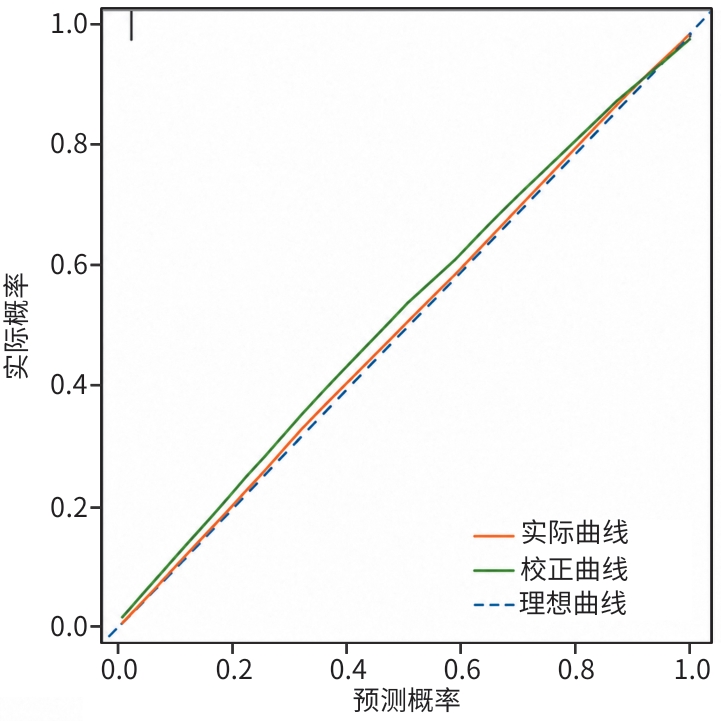
目的 基于人中性粒细胞载脂蛋白(HNL)等相关指标构建临床模型,分析其在老年急性梗阻性化脓性胆管炎(AOSC)合并肝损伤患者急性肾损伤(AKI)早期诊断中的应用价值。 方法 选择2022年4月—2025年6月中国人民解放军联勤保障部队第九八〇医院收治的老年AOSC合并肝损伤患者161例,根据患者是否并发AKI,将其分为AKI组(n=73)以及非AKI组(n=88);根据肾功能损伤严重程度,将AKI组进一步分为轻度组(n=35)、中度组(n=25)、重度组(n=13)。采用酶联免疫吸附分析法检测血清HNL表达水平,并收集患者相关临床资料及生化指标检测结果,分析可能影响AOSC合并肝损伤患者AKI发生的相关因素。符合正态分布的计量资料两组间比较采用独立样本t检验;多组间等级资料比较采用Kruskal-Wallis H检验;计数资料组间比较采用χ²检验。采用 Pearson 相关分析评价血清HNL水平与血肌酐(Scr)、血尿素氮等指标之间的相关性。采用多因素Logistic回归分析筛选AOSC合并肝损伤患者发生AKI的独立影响因素。基于多因素Logistic回归分析结果构建列线图,采用受试者操作特征曲线及曲线下面积(AUC)评价模型预测效能,并采用DeLong检验比较不同预测指标间AUC的差异。采用一致性指数(C指数)、校准曲线及Hosmer-Lemeshow拟合优度检验评价列线图模型的区分度和校准度。 结果 AKI组患者血清HNL水平显著高于非AKI组(t=11.087,P<0.001);不同AKI病情分级患者血清HNL水平比较,差异有统计学意义(H=40.100,P<0.001),中度组及重度组血清HNL水平显著高于轻度组,重度组血清HNL水平显著高于中度组(P值均<0.05)。相关性分析显示,血清HNL水平与Scr、血尿素氮水平均呈显著正相关(r值分别为0.473、0.258,P值均<0.001)。多因素Logistic回归分析结果显示,HNL[比值比(OR)=4.362,95%置信区间(CI):1.526~12.473,P=0.006]、急性生理与慢性健康评分Ⅱ(OR=4.595,95%CI:1.471~14.350,P=0.009)、Scr(OR=4.894,95%CI:1.415~16.923,P=0.012)、C反应蛋白(OR=4.141,95%CI:1.077~15.919,P=0.039)、年龄(OR=4.958,95%CI:1.204~20.412,P=0.027)及乳酸(OR=5.307,95%CI:1.264~22.281,P=0.023)为AOSC合并肝损伤患者发生AKI的独立影响因素。根据上述结果构建列线图模型,采用受试者操作特征曲线评估HNL、Scr以及上述模型对AOSC合并肝损伤患者AKI发生的识别效能,其AUC分别为0.875、0.819以及0.946,模型的AUC显著高于HNL和Scr(Z值分别为-2.155、-3.301,P值均<0.05)。列线图模型C指数为0.983(P<0.05),拟合优度检验结果显示模型具有较高的准确度以及良好的拟合度(χ2=0.428,P=0.895)。 结论 基于HNL、急性生理与慢性健康评分Ⅱ、Scr、C反应蛋白、年龄及乳酸构建的列线图模型,能够更全面、准确地识别AKI高危患者,为临床医生提供了一种简便、直观的风险评估工具,有助于在老年AOSC合并肝损伤患者中实现AKI的早期预警和个体化干预。 -
关键词:
- 急性梗阻性化脓性胆管炎 /
- 急性肾损伤 /
- 人中性粒细胞载脂蛋白 /
- 列线图
Abstract:Objective To construct a clinical prediction model based on human neutrophil lipocalin (HNL) and other related indicators, and to investigate its application value in the early diagnosis of acute kidney injury (AKI) in elderly patients with acute obstructive suppurative cholangitis (AOSC) and liver injury. Methods A total of 161 elderly patients with AOSC and liver injury who were admitted to The 980th Hospital of Joint Logistic Support Force of Chinese People’s Liberation Army from April 2022 to June 2025 were enrolled, and according to the presence or absence of AKI, they were divided into AKI group with 73 patients and non-AKI group with 88 patients. According to the severity of AKI, the AKI group was further divided into mild group with 35 patients, moderate group with 25 patients, and severe group with 13 patients. ELISA was used to measure the serum level of HNL, and related clinical data and biochemical parameters were collected to analyze the influencing factors for AKI in patients with AOSC and liver injury. The independent samples t-test was used for comparison of normally distributed continuous data between two groups; the Kruskal-Wallis H test was used for comparison of ranked data between multiple groups; the chi-square test was used for comparison of categorical data between groups. The Pearson correlation analysis was used to investigate the correlation of serum HNL level with renal function parameters such as serum creatinine (Scr) and blood urea nitrogen (BUN). The multivariate Logistic regression analyses was used to identify independent influencing factors for AKI in the patients with AOSC and liver injury, and a nomogram was constructed based on the results of the multivariate Logistic regression analysis. The receiver operating characteristic (ROC) curve and the area under the ROC curve (AUC) were used to assess the predictive performance of the model, and the DeLong test was used to compare the AUC of different predictive indicators. C-index, calibration curve, and the Hosmer-Lemeshow goodness-of-fit test were used to assess the discriminatory ability and calibration of the nomogram model. Results The AKI group had a significantly higher serum level of HNL than the non-AKI group (t=11.087, P<0.001). There was a significant difference in the serum level of HNL across the patients with different severities of AKI (H=40.100, P<0.001); the moderate group and the severe group had a significantly higher serum level of HNL than the mild group, and the severe group had a significantly higher serum level of HNL than the moderate group (all P<0.05). The correlation analysis showed that the serum level of HNL was significantly positively correlated with Scr and BUN (r=0.473 and 0.258, both P<0.001). The multivariate Logistic regression analyses showed that HNL (odds ratio [OR]=4.362, 95% confidence interval [CI]: 1.526 — 12.473, P=0.006), Acute Physiology and Chronic Health Evaluation Ⅱ (APACHE Ⅱ) score (OR=4.595, 95%CI: 1.471 — 14.350, P=0.009), Scr (OR=4.894, 95%CI: 1.415 — 16.923, P=0.012), C-reactive protein (OR=4.141, 95%CI: 1.077 — 15.919, P=0.039), age (OR=4.958, 95%CI: 1.204 — 20.412, P=0.027), and lactate (OR=5.307, 95%CI: 1.264 — 22.281, P=0.023) were independent influencing factors for AKI in patients with AOSC and liver injury. A nomogram model was established based on the above results, and the ROC curve analysis showed that HNL, Scr, and the above nomogram model had an AUC of 0.875, 0.819, and 0.946, respectively, in predicting AKI in the patients with AOSC and liver injury, and the model had a significantly larger AUC than HNL and Scr (Z=-2.155 and -3.301, both P<0.05). The nomogram model had a C-index of 0.983 (P<0.05), and the goodness-of-fit test showed χ2=0.428 and P=0.895, suggesting that the model had relatively high accuracy and good fitness. Conclusion The nomogram model constructed based on HNL, APACHE Ⅱ score, Scr, C-reactive protein, age, and lactate can more comprehensively and accurately identify patients at a high risk of AKI and provides clinicians with a simple and intuitive risk assessment tool, so as to help with the early warning and individualized intervention of AKI in elderly patients with AOSC and liver injury. -
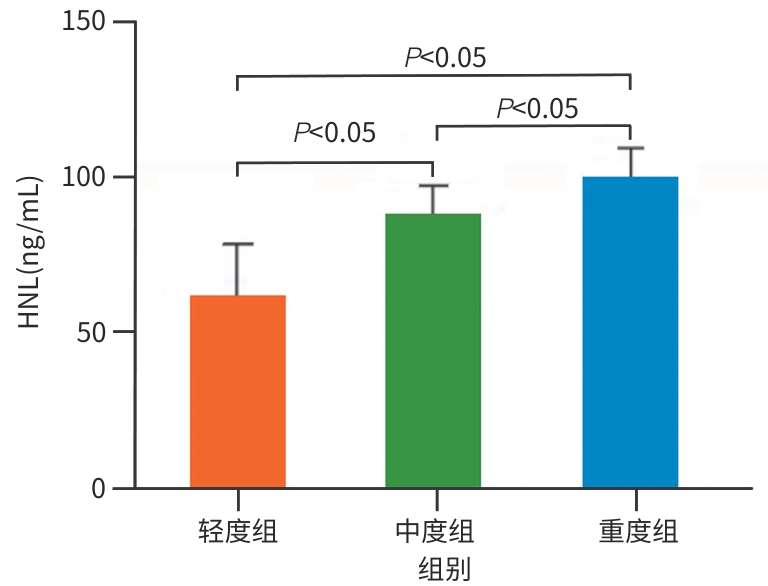
注: AKI,急性肾损伤;HNL,人中性粒细胞载脂蛋白。
图 1 不同AKI病情分级患者血清HNL水平
Figure 1. Serum HNL levels in patients with different AKI disease grades
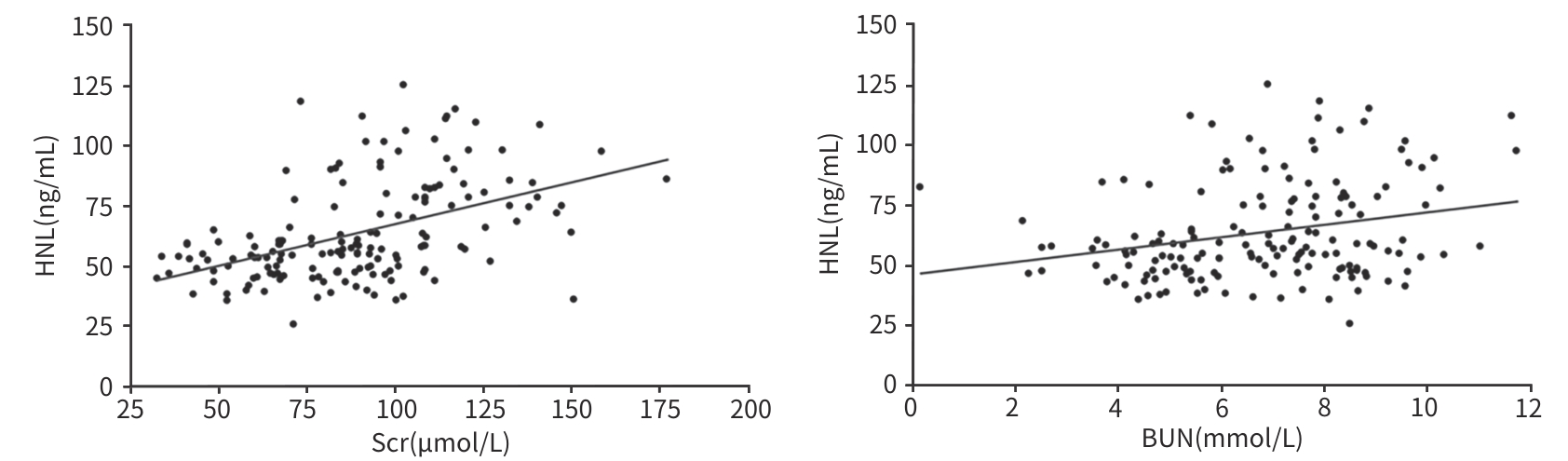
注: HNL,人中性粒细胞载脂蛋白;Scr,血肌酐;BUN,血尿素氮。
图 2 血清HNL与Scr、BUN相关性分析散点图
Figure 2. Scatter plot of the correlation analysis between serum HNL and Scr, BUN
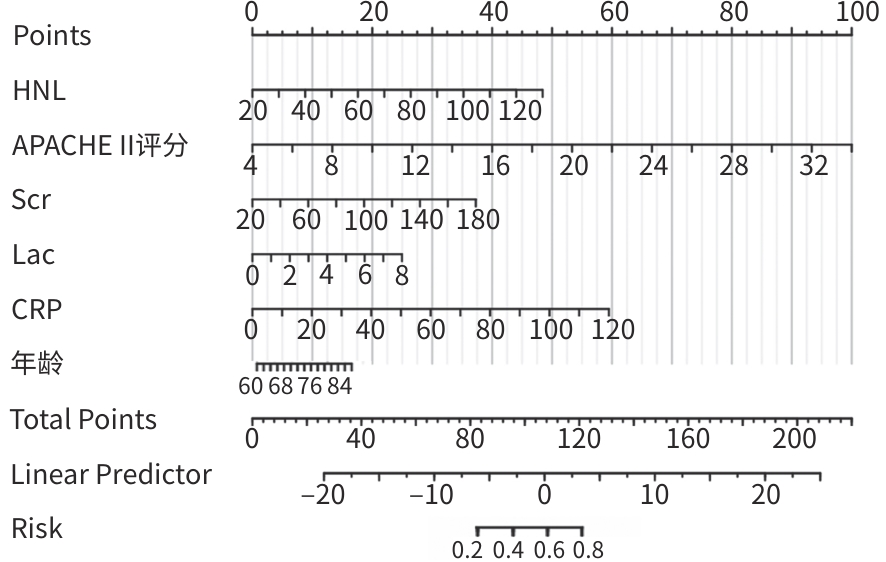
注: HNL,人中性粒细胞载脂蛋白;APACHE Ⅱ评分,急性生理与慢性健康评分Ⅱ;Scr,血肌酐;CRP,C反应蛋白;Lac,乳酸。
图 3 列线图模型
Figure 3. Nomogram model
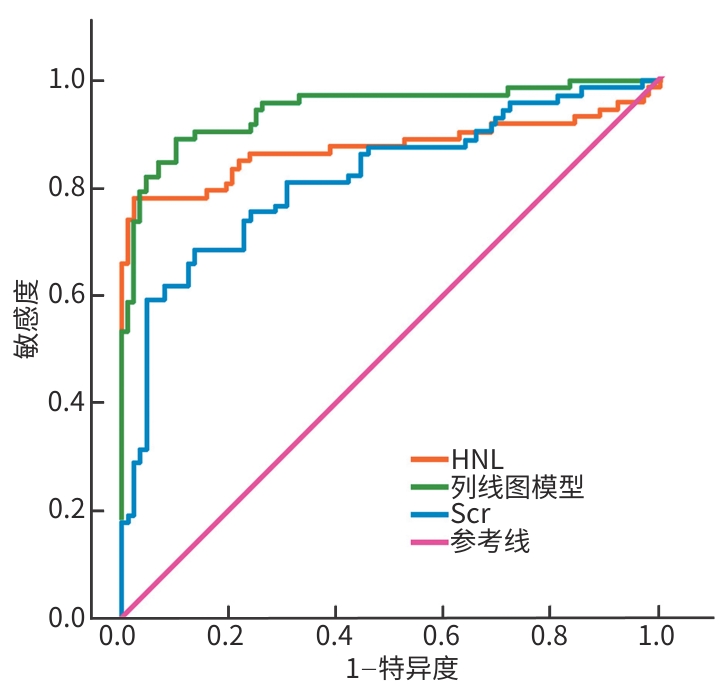
注: HNL,人中性粒细胞载脂蛋白;Scr,血肌酐;ROC曲线,受试者操作特征曲线。
图 4 HNL、Scr及列线图模型的ROC 曲线
Figure 4. ROC curves of HNL,Scr and nomogram model
表 1 两组患者临床资料及生化指标比较
Table 1. Comparison of clinical data and biochemical indicators between the two groups
项目 AKI组(n=73) 非AKI组(n=88) 统计值 P值 性别[例(%)] χ2=0.211 0.646 男 38(52.05) 49(55.68) 女 35(47.95) 39(44.32) 年龄(岁) 73.42±6.20 69.02±5.05 t=4.963 <0.001 高血压[例(%)] 35(47.95) 36(40.91) χ2=0.801 0.371 糖尿病[例(%)] 29(39.73) 28(31.82) χ2=1.091 0.296 冠心病[例(%)] 22(30.14) 24(27.27) χ2=0.160 0.689 APACHE Ⅱ评分(分) 17.37±4.22 12.10±3.23 t=8.970 <0.001 SOFA评分(分) 7.32±2.15 3.44±1.20 t=14.439 <0.001 WBC(×109/L) 8.95±3.40 8.68±2.41 t=0.588 0.557 PLT(×109/L) 114.28±21.52 121.49±28.39 t=1.785 0.076 HGB(g/L) 107.93±18.50 113.42±24.03 t=1.598 0.112 PCT(ng/mL) 19.65±3.45 10.55±3.64 t=16.168 <0.001 CRP(mg/L) 57.38±17.32 32.18±14.26 t=10.126 <0.001 Scr(μmol/L) 108.35±24.73 73.29±19.48 t=10.061 <0.001 BUN(mmol/L) 7.38±2.10 6.27±1.89 t=3.527 <0.001 ALT(U/L) 71.49±21.04 64.59±19.05 t=2.182 0.031 AST(U/L) 93.52±31.05 87.59±22.47 t=1.403 0.163 Alb(g/L) 26.58±7.33 32.07±8.16 t=4.449 <0.001 TBil(μmol/L ) 52.38±20.32 46.48±19.82 t=1.859 0.065 Lac(mmol/L) 4.23±1.75 2.42±0.98 t=8.268 <0.001 HNL(ng/mL) 78.49±21.59 51.23±7.42 t=11.087 <0.001 注:APACHE Ⅱ评分,急性生理与慢性健康评分Ⅱ;SOFA,序贯器官衰竭评分;WBC,白细胞计数;PLT,血小板计数;HGB,血红蛋白;PCT,降钙素原;CRP,C反应蛋白;Scr,血肌酐;BUN,血尿素氮;ALT,丙氨酸氨基转移酶;AST,天冬氨酸氨基转移酶;Alb,白蛋白;TBil,总胆红素;Lac,乳酸;HNL,人中性粒细胞载脂蛋白。
 下载: 导出CSV
表 2 影响患者AKI发生的多因素Logistic回归分析
Table 2. Multivariate Logistic regression analysis of multiple factors influencing the occurrence of AKI in patients
因素 b值 SE χ2值 OR 95%CI P值 HNL(ng/mL) 1.473 0.536 7.552 4.362 1.526~12.473 0.006 APACHE Ⅱ评分(分) 1.525 0.581 6.889 4.595 1.471~14.350 0.009 Scr(μmol/L) 1.588 0.633 6.294 4.894 1.415~16.923 0.012 CRP(mg/L) 1.421 0.687 4.278 4.141 1.077~15.919 0.039 年龄(岁) 1.601 0.722 4.917 4.958 1.204~20.412 0.027 Lac(mmol/L) 1.669 0.732 5.199 5.307 1.264~22.281 0.023 注:HNL,人中性粒细胞载脂蛋白;APACHE Ⅱ评分,急性生理与慢性健康评分Ⅱ;Scr,血肌酐;CRP,C反应蛋白;Lac,乳酸;SE,标准误;OR,比值比;CI,置信区间。
下载: 导出CSV
-
[1] Cao Lijun, Huang Yingwen, He Xueqiang, et al. Efficacy and safety of emergency endoscopic retrograde cholangiopancreatography in super elderly patients with acute obstructive suppurative cholangitis[J]. J Pract Med, 2022, 38( 23): 2957- 2961. DOI: 10.3969/j.issn.1006-5725.2022.23.012.曹立军, 黄应文, 贺学强, 等. 超高龄急性梗阻性化脓性胆管炎急诊经内镜逆行胰胆管造影术治疗的有效性及安全性分析[J]. 实用医学杂志, 2022, 38( 23): 2957- 2961. DOI: 10.3969/j.issn.1006-5725.2022.23.012. [2] Yuan Shiyu, Yang Huanhuan, Tang Yingmei. Research advances in primary biliary cholangitis with dyslipidemia[J]. J Clin Hepatol, 2024, 40( 1): 151- 156. DOI: 10.12449/JCH240125.袁诗雨, 杨焕焕, 唐映梅. 原发性胆汁性胆管炎合并脂质代谢异常的研究进展[J]. 临床肝胆病杂志, 2024, 40( 1): 151- 156. DOI: 10.12449/JCH240125. [3] Zhang T F, Widdop R E, Ricardo S D. Transition from acute kidney injury to chronic kidney disease: Mechanisms, models, and biomarkers[J]. Am J Physiol Renal Physiol, 2024, 327( 5): F788- F805. DOI: 10.1152/ajprenal.00184.2024. [4] He Xiaoqin, Yang Min, Dai En. Clinical characteristics and prognostic risk factors of malignant tumor-related acute kidney injuries[J]. J Cancer Control Treat, 2022, 35( 10): 929- 933. DOI: 10.3969/j.issn.1674-0904.2022.10.007.何小勤, 杨敏, 代恩. 恶性肿瘤相关急性肾损伤(AKI)的临床特点及预后危险因素分析[J]. 肿瘤预防与治疗, 2022, 35( 10): 929- 933. DOI: 10.3969/j.issn.1674-0904.2022.10.007. [5] Holt A, Rahm J, Hopper H A, et al. Acute kidney injury: Iterative development of an audit tool for trauma patients[J]. J Trauma Nurs, 2023, 30( 2): 108- 114. DOI: 10.1097/JTN.0000000000000710. [6] Zhang P, Jiang N, Xu L M, et al. Clostridium perfringens and Escherichia coli bacteremia in a patient with acute obstructive suppurative cholangitis: A case report and review of the literature[J]. Am J Case Rep, 2022, 23: e936329. DOI: 10.12659/AJCR.936329. [7] Zhang Zongming, Dong Jiahong, Chen Xiaoping. Research progress of minimally invasive treatment for acute obstructive suppurative cholan-gitis in extremely elderly patients[J]. Chin J Dig Surg, 2025, 24( 7): 815- 821. DOI: 10.3760/cma.j.cn115610-20250706-00455.张宗明, 董家鸿, 陈孝平. 高龄急性梗阻性化脓性胆管炎微创治疗的研究进展[J]. 中华消化外科杂志, 2025, 24( 7): 815- 821. DOI: 10.3760/cma.j.cn115610-20250706-00455. [8] Bülow Anderberg S, Lipcsey M, Hultström M, et al. Systemic human neutrophil lipocalin associates with severe acute kidney injury in SARS-CoV-2 pneumonia[J]. J Clin Med, 2021, 10( 18): 4144. DOI: 10.3390/jcm10184144. [9] Jiang Yingying, Wang Jingyu, Kong Yan, et al. Association between neutrophil to lymphocyte ratio and renal tubular injury in type 2 diabetes mellitus patients[J]. Tianjin Med J, 2022, 50( 1): 83- 87. DOI: 10.11958/20211431.姜莹莹, 王靖宇, 孔岩, 等. 中性粒细胞/淋巴细胞比值与2型糖尿病患者肾小管损伤的相关性研究[J]. 天津医药, 2022, 50( 1): 83- 87. DOI: 10.11958/20211431. [10] Hu Fenglin, Shang Dong, Zhang Haoxiang, et al. A review of Tokyo Guidelines 2018 for the management of acute biliary infections[J]. Chin J Pract Surg, 2018, 38( 7): 763- 766. DOI: 10.19538/j.cjps.issn1005-2208.2018.07.15.胡凤林, 尚东, 张浩翔, 等.《东京指南(2018)》急性胆道感染诊疗策略更新解读[J]. 中国实用外科杂志, 2018, 38( 7): 763- 766. DOI: 10.19538/j.cjps.issn1005-2208.2018.07.15. [11] Acute Kidney Injury Expert Consensus Group. General understanding on the diagnosis and classification of acute kidney injury[J]. Chin J Nephrol, 2006, 22( 11): 661- 663. DOI: 10.3760/j.issn:1001-7097.2006.11.005.急性肾损伤专家共识小组. 急性肾损伤诊断与分类专家共识[J]. 中华肾脏病杂志, 2006, 22( 11): 661- 663. DOI: 10.3760/j.issn: 1001-7097.2006.11.005. [12] Oura H, Sugiyama H, Nishino T. A case of acute obstructive suppurative pancreatic ductitis complicated with acute cholangitis diagnosed only after the removal of a pancreatic duct stent[J]. DEN Open, 2024, 4( 1): e352. DOI: 10.1002/deo2.352. [13] Yamada K, Shinoura S. Unusual biliary gem: Cause of acute obstructive suppurative cholangitis and pancreatitis in a patient with Billroth II anastomosis[J]. Ann Acad Med Singap, 2022, 51( 3): 196- 197. DOI: 10.47102/annals-acadmedsg.2021376. [14] Li K, Zhu S B, Ye C, et al. Endotoxin retention in adipose tissue leading to persistent hypotension in catecholamine-dependent acute obstructive suppurative cholangitis[J]. J Transl Int Med, 2025, 13( 6): 537- 558. DOI: 10.1515/jtim-2025-0053. [15] Lu J J, Fan Z. ERCP endoscopic minimally invasive treatment of acute suppurative obstructive cholangitis: A study of 47 patients[J]. Exp Ther Med, 2024, 27( 4): 128. DOI: 10.3892/etm.2024.12416. [16] Meng M, Feng H, Tang S, et al. Efficacy of ultrasound-guided percutaneous transhepatic biliary drainage for acute obstructive suppurative cholangitis combined with septic shock[J]. Clinics(Sao Paulo), 2023, 78: 100258. DOI: 10.1016/j.clinsp.2023.100258. [17] Zhang Z M, Dong J H, He X D, et al. Challenges of minimally invasive treatment for acute obstructive suppurative cholangitis in elderly patients[J]. Chin Med J, 2025, 138( 17): 2198- 2200. DOI: 10.1097/CM9.0000000000003646. [18] Sheng Xia, Ji Qingming, Li Xinyu, et al. Advances in drug therapy for primary sclerosing cholangitis[J]. J Clin Hepatol, 2024, 40( 5): 1032- 1038. DOI: 10.12449/JCH240526.盛夏, 纪庆明, 李昕宇, 等. 原发性硬化性胆管炎药物治疗进展[J]. 临床肝胆病杂志, 2024, 40( 5): 1032- 1038. DOI: 10.12449/JCH240526. [19] Yu S, Fang J M, Zhang C, et al. Endoscopic ultrasound–guided gallbladder drainage combined with endoscopic retrograde cholangiopancreatography for severe pancreatitis complicated by acute obstructive suppurative cholangitis and calculous cholecystitis(with video)[J]. Gastrointest Endosc, 2026, 103( 2): 360- 361. DOI: 10.1016/j.gie.2025.08.005. [20] Zhu Yu, Jia Weidong. Application of minimally invasive technique in the treatment of acute obstructive suppurative cholangitis[J]. Int J Surg, 2021, 48( 10): 690- 694. DOI: 10.3760/cma.j.cn115396-20211012-00394.朱昱, 荚卫东. 微创技术在急性梗阻性化脓性胆管炎治疗中的应用[J]. 国际外科学杂志, 2021, 48( 10): 690- 694. DOI: 10.3760/cma.j.cn115396-20211012-00394. [21] Han Hongxi, Pan Longfei, Fu Nan, et al. Efficacy of PTCD and ERCP for treatment of acute obstructive suppurative cholangitis in elderly patients[J]. J Tongji Univ Med Sci, 2020, 41( 4): 482- 486. DOI: 10.16118/j.1008-0392.2020.04.014.韩宏喜, 潘龙飞, 付楠, 等. PTCD与ERCP对急性梗阻化脓性胆管炎老年患者炎症反应的对比研究[J]. 同济大学学报(医学版), 2020, 41( 4): 482- 486. DOI: 10.16118/j.1008-0392.2020.04.014. [22] Wu J, Lu J, Jia Z. Rescue for an advanced aging patient with synchronous AOSC and gallstone ileus: A case report and literature review[J]. Front Surg, 2025, 12: 1685238. DOI: 10.3389/fsurg.2025.1685238. [23] Huang Xiaoxing, Zeng Weijian, Luo Weijie, et al. Relationship between gastrointestinal function score,SOFA score, serum inflammatory indexes and clinical outcomes in patients with sepsis complicated with gastrointestinal dysfunction[J]. J Clin Exp Med, 2024, 23( 22): 2365- 2368. DOI: 10.3969/j.issn.1671-4695.2024.22.004.黄晓星, 曾伟坚, 罗伟杰, 等. 脓毒症胃肠功能障碍患者APACHE Ⅱ评分、SOFA评分及血清炎症指标与临床转归的关系研究[J]. 临床和实验医学杂志, 2024, 23( 22): 2365- 2368. DOI: 10.3969/j.issn.1671-4695.2024.22.004. [24] Xu Caiyun, Lu Junhong, Wang Hongyin. Analysis of influencing factors of death in patients with acute obstructive suppurative cholangitis after percutaneous transhepatic cholangial drainage[J/CD]. Chin J Front Med Sci: Electronic Version, 2020, 12( 3): 142- 145. DOI: 10.12037/YXQY.2020.03-27.徐彩云, 卢俊红, 王红银. 急性梗阻性化脓性胆管炎患者经皮肝穿刺胆道引流术后死亡的影响因素分析[J/CD]. 中国医学前沿杂志(电子版), 2020, 12( 3): 142- 145. DOI: 10.12037/YXQY.2020.03-27. [25] Yu Kui, Liang Xiaoqiang, Han Mian, et al. Optimization and evaluation of acute obstructive suppurative cholangitis model in rats[J]. Chin J Comp Med, 2024, 34( 3): 45- 50. DOI: 10.3969/j.issn.1671-7856.2024.03.006.余奎, 梁晓强, 韩冕, 等. 大鼠急性梗阻性化脓性胆管炎模型的建立与评估[J]. 中国比较医学杂志, 2024, 34( 3): 45- 50. DOI: 10.3969/j.issn.1671-7856.2024.03.006. -

 本文二维码
计量
- 文章访问数: 20
- HTML全文浏览量: 7
- PDF下载量: 1
- 被引次数: 0