PDF下载 ( 1229 KB)

外泌体微RNA在肝衰竭中的调控作用机制及临床应用前景
DOI: 10.12449/JCH261034
利益冲突声明:本文不存在任何利益冲突。
作者贡献声明:木衣司尔·艾买提江负责查阅文献,起草文章;郑嵘炅、鲁晓擘负责拟定课题,设计写作思路,指导撰写文章并最后定稿。
Regulatory mechanism and clinical application prospect of exosomal microRNAs in liver failure
-
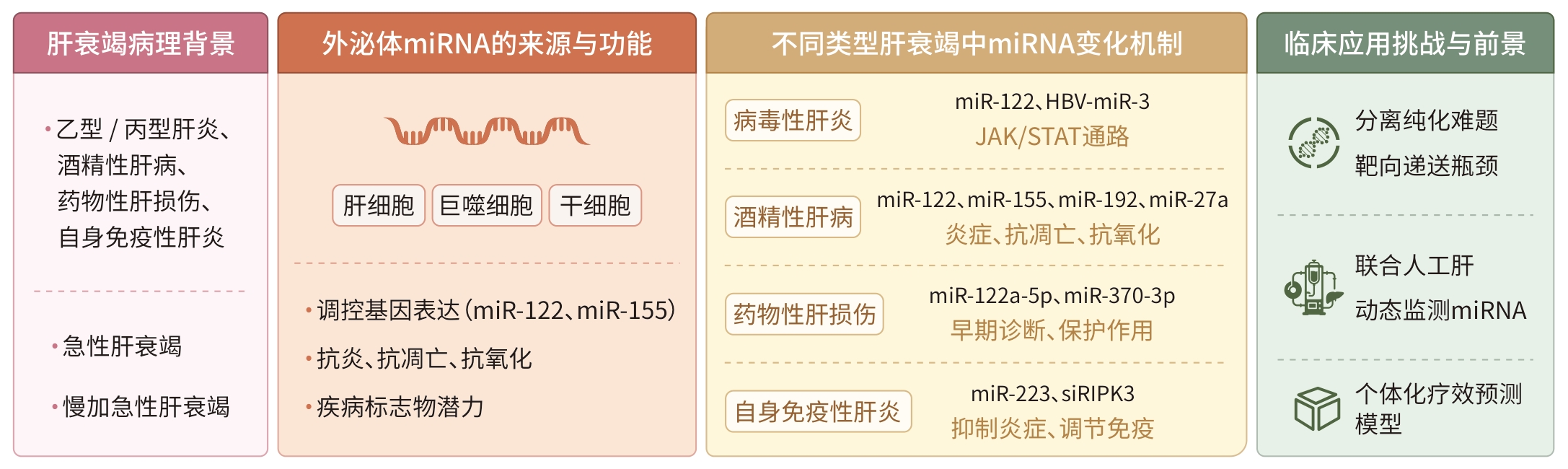
摘要: 肝衰竭是由多种病因引起的严重临床综合征,其发生发展与外泌体及其携带的微RNA(miRNA)调控密切相关。研究表明,在病毒性肝炎、酒精性肝病、药物性肝损伤及自身免疫性肝炎等不同病因导致的肝损伤中,外泌体可通过递送特定miRNA(如miR-122、miR-155及miR-192等),调节炎症反应、细胞死亡、免疫应答及组织修复等过程,进而影响肝衰竭的进展。此外,外泌体miRNA不仅可作为肝衰竭早期诊断与预后评估的潜在生物标志物,还有望成为miRNA干预的治疗靶点。本文总结外泌体miRNA在肝衰竭中的相关作用机制,并展望其临床转化方向,为肝衰竭的精准诊疗提供理论依据。Abstract: Liver failure is a severe clinical syndrome caused by various etiologies, and its development and progression are closely associated with the regulation by exosomes and the microRNAs (miRNAs) carried by exosomes. Studies have shown that in liver injury caused by various etiologies such as viral hepatitis, alcoholic liver disease, drug-induced liver injury, and autoimmune hepatitis, exosomes can deliver specific miRNAs (such as miR-122, miR-155, and miR-192) and regulate the processes including inflammatory response, cell death, immune response, and tissue repair, thereby affecting the progression of liver failure. Furthermore, exosomal miRNAs hold the potential as biomarkers for the early diagnosis and prognostic evaluation of liver failure and are also expected to become therapeutic targets for miRNA-based interventions. This article summarizes the mechanism of action of exosomal miRNAs in liver failure and explores the directions for their clinical translation, so as to provide a theoretical basis for the precise diagnosis and treatment of liver failure.
-
Key words:
- Liver Failure /
- Exosomes /
- MicroRNAs /
- Biomarkers
-
[1] Artificial Liver Group, Chinese Society of Hepatology, Chinese Medical Association; Nutrition and Regeneration in End-Stage Liver Disease Group, Chinese Society of Hepatology, Chinese Medical Association. Guidelines for the diagnosis and treatment of acute-on-chronic liver failure(2025 version)[J]. J Pract Hepatol, 2025, 28( 5): 641- 647. DOI: 10.3969/j.issn.1672-5069.2025.05.001.中华医学会肝病学分会重型肝病与人工肝学组, 中华医学会肝病学分会终末期肝病营养与再生学组. 慢加急性肝衰竭诊治指南(2025年版)[J]. 实用肝脏病杂志, 2025, 28( 5): 641- 647. DOI: 10.3969/j.issn.1672-5069.2025.05.001. [2] Xie Q, Gu J D. Therapeutic and safety promise of mesenchymal stem cells for liver failure: From preclinical experiment to clinical application[J]. Curr Stem Cell Res Ther, 2024, 19( 10): 1351- 1368. DOI: 10.2174/011574888X260690230921174343. [3] Dong V, Karvellas C J. Liver assistive devices in acute liver failure: Current use and future directions[J]. Best Pract Res Clin Gastroenterol, 2024, 73: 101964. DOI: 10.1016/j.bpg.2024.101964. [4] Hua Tianzhen, Ma Yushi, Fang He. The mechanism and progress of stem cells in the treatment of hepatocyte injury[J]. J Pract Med, 2021, 37( 7): 839- 844. DOI: 10.3969/j.issn.1006-5725.2021.07.003.华天桢, 马雨诗, 房贺. 干细胞在肝损伤治疗中的应用与机制[J]. 实用医学杂志, 2021, 37( 7): 839- 844. DOI: 10.3969/j.issn.1006-5725.2021.07.003. [5] Sarin S K, Choudhury A. Acute-on-chronic liver failure: Terminology, mechanisms and management[J]. Nat Rev Gastroenterol Hepatol, 2016, 13( 3): 131- 149. DOI: 10.1038/nrgastro.2015.219. [6] Liang Yue, Hu Yonghong, Liu Wei, et al. Research advances in bone marrow mesenchymal stem cells and its exosomes in treatment of end-stage liver disease[J]. J Clin Hepatol, 2022, 38( 11): 2643- 2648. DOI: 10.3969/j.issn.1001-5256.2022.11.041.梁悦, 胡永红, 刘伟, 等. 骨髓间充质干细胞及其外泌体治疗终末期肝病的研究进展[J]. 临床肝胆病杂志, 2022, 38( 11): 2643- 2648. DOI: 10.3969/j.issn.1001-5256.2022.11.041. [7] Jiao Y, Xu P, Shi H L, et al. Advances on liver cell-derived exosomes in liver diseases[J]. J Cell Mol Med, 2021, 25( 1): 15- 26. DOI: 10.1111/jcmm.16123. [8] Fagoonee S, Menchise V, Delli Castelli D, et al. Emerging biomarker potential of extracellular vesicle-enclosed microRNAs for liver fibrosis detection[J]. Cells, 2025, 14( 13): 1025. DOI: 10.3390/cells14131025. [9] Maiese A, Scatena A, Costantino A, et al. Expression of microRNAs in sepsis-related organ dysfunction: A systematic review[J]. Int J Mol Sci, 2022, 23( 16): 9354. DOI: 10.3390/ijms23169354. [10] Tang H X, Lu W, Yang Q, et al. Exosomes derived from 3D-cultured hUCMSCs exhibit superior hepatoprotection against ALF[J]. IScience, 2025, 28( 9): 113419. DOI: 10.1016/j.isci.2025.113419. [11] He Quanwei, Xu Ran, Han Wei, et al. Association of serum exosomal miR-122-5p with the prognosis of hepatic confluent necrosis and fibrosis in patients with chronic hepatitis B[J]. J Clin Hepatol, 2025, 41( 5): 888- 899. DOI: 10.12449/JCH250514.何权威, 徐然, 韩葳, 等. 慢性乙型肝炎患者血清外泌体miR-122-5p表达水平与肝脏融合性坏死和纤维化转归的关系[J]. 临床肝胆病杂志, 2025, 41( 5): 888- 899. DOI: 10.12449/JCH250514. [12] Zhao X Q, Sun L, Mu T, et al. An HBV-encoded miRNA activates innate immunity to restrict HBV replication[J]. J Mol Cell Biol, 2020, 12( 4): 263- 276. DOI: 10.1093/jmcb/mjz104. [13] Saha B, Momen-Heravi F, Furi I, et al. Extracellular vesicles from mice with alcoholic liver disease carry a distinct protein cargo and induce macrophage activation through heat shock protein 90[J]. Hepatology, 2018, 67( 5): 1986- 2000. DOI: 10.1002/hep.29732. [14] Verma V K, Li H Y, Wang R S, et al. Alcohol stimulates macrophage activation through caspase-dependent hepatocyte derived release of CD40L containing extracellular vesicles[J]. J Hepatol, 2016, 64( 3): 651- 660. DOI: 10.1016/j.jhep.2015.11.020. [15] Bandiera S, Pfeffer S, Baumert T F, et al. miR-122-A key factor and therapeutic target in liver disease[J]. J Hepatol, 2015, 62( 2): 448- 457. DOI: 10.1016/j.jhep.2014.10.004. [16] Babuta M, Furi I, Bala S, et al. Dysregulated autophagy and lysosome function are linked to exosome production by micro-RNA 155 in alcoholic liver disease[J]. Hepatology, 2019, 70( 6): 2123- 2141. DOI: 10.1002/hep.30766. [17] Parthasarathy G, Hirsova P, Kostallari E, et al. Extracellular vesicles in hepatobiliary health and disease[J]. Compr Physiol, 2023, 13( 3): 4631- 4658. DOI: 10.1002/cphy.c210046. [18] Bu Tong, Wang Qi. Interpretation of the 2023 Chinese Guidelines for the diagnosis and treatment of drug-induced liver injury[J]. Clin Medicat J, 2024, 22( 11): 7- 12. DOI: 10.3969/j.issn.1672-3384.2024.11.002.布橦, 王琦.《中国药物性肝损伤诊治指南2023年版》解读[J]. 临床药物治疗杂志, 2024, 22( 11): 7- 12. DOI: 10.3969/j.issn.1672-3384.2024.11.002. [19] Ogese M O, Jenkins R E, Adair K, et al. Exosomal transport of hepatocyte-derived drug-modified proteins to the immune system[J]. Hepatology, 2019, 70( 5): 1732- 1749. DOI: 10.1002/hep.30701. [20] Motawi TK, Mohamed MR, Shahin NN, et al. Time-course expression profile and diagnostic potential of a miRNA panel in exosomes and total serum in acute liver injury[J]. Int J Biochem Cell Biol, 2018, 100: 11- 21. DOI: 10.1016/j.biocel.2018.05.002. [21] Zhu L, Zhao L, Wang Q, et al. Circulating exosomal miRNAs and cancer early diagnosis[J]. Clin Transl Oncol, 2022, 24( 3): 393- 406. DOI: 10.1007/s12094-021-02706-6. [22] Tan C Y, Lai R C, Wong W, et al. Mesenchymal stem cell-derived exosomes promote hepatic regeneration in drug-induced liver injury models[J]. Stem Cell Res Ther, 2014, 5( 3): 76. DOI: 10.1186/scrt465. [23] Luo Longlong, Wang Lifei, Zheng Ying, et al. Research advances in mesenchymal stem cells and their exosomes in treatment of autoimmune hepatitis[J]. J Clin Hepatol, 2023, 39( 12): 2920- 2925. DOI: 10.3969/j.issn.1001-5256.2023.12.025.罗龙龙, 王丽菲, 郑英, 等. 间充质干细胞及其外泌体治疗自身免疫性肝炎的研究进展[J]. 临床肝胆病杂志, 2023, 39( 12): 2920- 2925. DOI: 10.3969/j.issn.1001-5256.2023.12.025. [24] Fagoonee S, Bolontrade M F, Defilippi P, et al. The role of extracellular vesicles in mediating signaling in biliary epithelial cell activation and cholangiopathies[J]. Cells, 2025, 14( 16): 1274. DOI: 10.3390/cells14161274. [25] Zhang Yongting. Mechanistic study of macrophage exosome-derived long non-coding RNA H19 aggravating autoimmune hepatitis[C]//Zhejiang Society for Immunology. Proceedings of the 13th Academic Conference of Zhejiang Society for Immunology. The First Affiliated Hospital, Zhejiang University School of Medicine, 2023: 42. DOI: 10.26914/c.cnkihy.2023.119649.张永婷. 巨噬细胞外泌体来源的长链非编码RNA H19加重自身免疫性肝炎的机制研究[C]//浙江省免疫学会. 浙江省免疫学会第十三次学术大会论文集. 浙江大学医学院附属第一医院, 2023: 42. DOI: 10.26914/c.cnkihy.2023.119649. [26] Zhang L, Liu M, Sun Q, et al. Engineering M2 type macrophage-derived exosomes for autoimmune hepatitis immunotherapy via loading siRIPK3[J]. Biomed Pharmacother, 2024, 171: 116161. DOI: 10.1016/j.biopha.2024.116161. [27] Lu F B, Chen D Z, Chen L, et al. Attenuation of experimental autoimmune hepatitis in mice with bone mesenchymal stem cell-derived exosomes carrying microRNA-223-3p[J]. Mol Cells, 2019, 42( 12): 906- 918. DOI: 10.14348/molcells.2019.2283. [28] Zhao J W, Li Y, Jia R R, et al. Mesenchymal stem cells-derived exosomes as dexamethasone delivery vehicles for autoimmune hepatitis therapy[J]. Front Bioeng Biotechnol, 2021, 9: 650376. DOI: 10.3389/fbioe.2021.650376. [29] Bala S, Tilahun Y, Taha O, et al. Increased microRNA-155 expression in the serum and peripheral monocytes in chronic HCV infection[J]. J Transl Med, 2012, 10: 151. DOI: 10.1186/1479-5876-10-151. [30] Jiao Y, Lu W, Xu P, et al. Hepatocyte-derived exosome may be as a biomarker of liver regeneration and prognostic valuation in patients with acute-on-chronic liver failure[J]. Hepatol Int, 2021, 15( 4): 957- 969. DOI: 10.1007/s12072-021-0217-3. [31] Xu W L, Yu M X, Wu Y K, et al. Plasma-derived exosomal SncRNA as a promising diagnostic biomarker for early detection of HBV-related acute-on-chronic liver failure[J]. Front Cell Infect Microbiol, 2022, 12: 923300. DOI: 10.3389/fcimb.2022.923300. [32] Cho H J, Eun J W, Baek G O, et al. Serum exosomal microRNA, miR-10b-5p, as a potential diagnostic biomarker for early-stage hepatocellular carcinoma[J]. J Clin Med, 2020, 9( 1): 281. DOI: 10.3390/jcm9010281. [33] Muñoz-Hernández R, Rojas Á, Gato S, et al. Extracellular vesicles as biomarkers in liver disease[J]. Int J Mol Sci, 2022, 23( 24): 16217. DOI: 10.3390/ijms232416217. [34] Ma Shuwei, He Sheng, Han Bing, et al. Exosomes derived from mesenchymal stem cells in treatment of animals with acute liver failure: A meta-analysis[J]. Chin J Tissue Eng Res, 2024, 28( 7): 1137- 1142. DOI: 10.12307/2024.113.马树微, 何生, 韩冰, 等. 间充质干细胞来源外泌体治疗动物急性肝衰竭的Meta分析[J]. 中国组织工程研究, 2024, 28( 7): 1137- 1142. DOI: 10.12307/2024.113. [35] Liu Y N, Lou G H, Li A C, et al. AMSC-derived exosomes alleviate lipopolysaccharide/d-galactosamine-induced acute liver failure by miR-17-mediated reduction of TXNIP/NLRP3 inflammasome activation in macrophages[J]. EBioMedicine, 2018, 36: 140- 150. DOI: 10.1016/j.ebiom.2018.08.054. [36] Gao Y, Wang J P, Hong D F, et al. Mesenchymal stem cell-mediated targeted drug delivery systems for hepatocellular carcinoma: Current advances and future directions[J]. Bioengineering(Basel), 2025, 12( 11): 1206. DOI: 10.3390/bioengineering12111206. [37] Wu B T, Feng J X, Wang X, et al. miR-19b-3p engineered adipose-derived stem cell exosomes attenuate acute liver failure via promoting tissue repair and microenvironment remodeling[J]. Mater Today Bio, 2026, 36: 102697. DOI: 10.1016/j.mtbio.2025.102697. [38] Tong Hua, Luo Yue, Wang Yadong. Regulatory mechanism of exosomes in liver failure and the application value in diagnosis and treatment[J]. J Clin Hepatol, 2024, 40( 9): 1897- 1901. DOI: 10.12449/JCH240928.童话, 罗越, 王亚东. 外泌体在肝衰竭中的调控机制及其在临床诊疗中的应用价值[J]. 临床肝胆病杂志, 2024, 40( 9): 1897- 1901. DOI: 10.12449/JCH240928. [39] Li F F, Xue T T, Xu Y T, et al. Microfluidic fabricated cell-laden microgels aggregated into artificial liver microtissue to ameliorate drug-induced liver injury[J]. Biomaterials, 2026, 326: 123710. DOI: 10.1016/j.biomaterials.2025.123710. -

 下载:
 本文二维码
图(1)
计量
- 文章访问数: 16
- HTML全文浏览量: 6
- PDF下载量: 1
- 被引次数: 0