PDF下载 ( 860 KB)

阿替利珠单抗联合贝伐珠单抗与信迪利单抗联合贝伐珠单抗生物类似物治疗不可切除肝细胞癌的效果比较
DOI: 10.12449/JCH260720
伦理学声明:本研究方案于2026年2月25日经首都医科大学附属北京地坛医院伦理委员会审批,批号为京地伦科字【2026】第(014)-01号。
利益冲突声明:本文不存在任何利益冲突。
作者贡献声明:刘晓民负责制定研究方案,提取数据,分析数据,撰写文章;赵青芳负责数据稽查,数据分析;孙巍负责制定研究方案,数据分析,文章编辑与订正;李文东负责制定研究方案,文章编辑与订正。
Efficacy of atezolizumab combined with bevacizumab versus sintilimab combined with bevacizumab biosimilar in treatment of unresectable hepatocellular carcinoma
-
摘要:
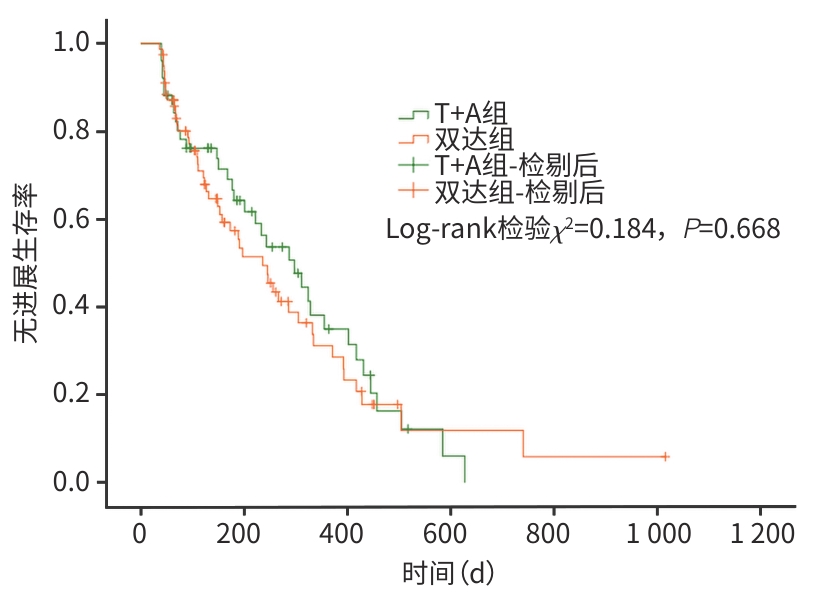
目的 比较真实世界中阿替利珠单抗联合贝伐珠单抗与信迪利单抗联合贝伐珠单抗生物类似物两种一线治疗方案,在不可切除肝细胞癌(HCC)患者中的疗效及安全性,为临床实践提供参考依据。 方法 回顾性纳入2020年1月—2026年1月于首都医科大学附属北京地坛医院就诊的130例不可切除HCC患者,所有患者的一线全身药物治疗方案为免疫检查点抑制剂联合贝伐珠单抗或其生物类似物。根据治疗方案分为阿替利珠单抗联合贝伐珠单抗组(T+A组,n=51)和信迪利单抗联合贝伐珠单抗生物类似物组(双达组,n=79)。主要观察终点为无进展生存期(PFS),次要观察终点包括客观缓解率(ORR)、疾病控制率(DCR)和安全性评价。计量资料两组间比较采用成组t检验或Wilcoxon秩和检验,计数资料两组间比较采用χ2检验。采用Kaplan-Meier法进行生存分析,组间比较采用Log-rank检验。 结果 T+A组的中位PFS为297.00 d(95%置信区间:195.44 d~398.56 d),双达组中位PFS为236.00 d(95%置信区间:165.10 d~306.90 d),两组间差异无统计学意义(P=0.668)。T+A组与双达组的ORR(56.9% vs 45.6%,χ2=1.581,P=0.209)、DCR(76.5% vs 77.2%,χ2=0.010,P=0.922)及不良事件发生率(96.08% vs 94.94%,P>0.05)差异均无统计学意义。 结论 对于全身药物初治的不可切除HCC患者,应用阿替利珠单抗联合贝伐珠单抗与信迪利单抗联合贝伐珠单抗生物类似物的PFS相似。 Abstract:Objective To investigate the efficacy and safety of atezolizumab combined with bevacizumab versus sintilimab combined with bevacizumab biosimilar in the treatment of patients with unresectable hepatocellular carcinoma (HCC) in a real-world setting, and to provide a reference for clinical practice. Methods A retrospective analysis was performed for 130 patients with unresectable HCC who were treated in Beijing Ditan Hospital, Capital Medical University, from January 2020 to January 2026, and all patients received the first-line systemic therapy with immune checkpoint inhibitors combined with bevacizumab or its biosimilar. According to the treatment regimen, the patients were divided into atezolizumab+bevacizumab group (T+A group with 51 patients) and sintilimab+bevacizumab biosimilar group (Shuangda group with 79 patients). The primary endpoint was progression-free survival (PFS), and secondary endpoints included objective response rate (ORR), disease control rate (DCR), and safety profile. The independent-samples t test or the Wilcoxon rank-sum test was used for comparison of continuous data between the two groups, and the chi-square test was used for comparison of categorical data between groups. The Kaplan-Meier method was used for survival analysis, and the Log-rank test was used for comparison between groups. Results The T+A group had a median PFS of 297.00 days (95% confidence interval [CI]: 195.44 — 398.56), and the Shuangda group had a median PFS of 236.00 days (95%CI: 165.10 — 306.90), with no significant difference between the two groups (P=0.668). There were no significant differences between the T+A group and the Shuangda group in ORR (56.9% vs 45.6%, χ2=1.581, P=0.209), DCR (76.5% vs 77.2%, χ2=0.010, P=0.922), and the incidence of adverse events (96.08% vs 94.94%, P>0.05). Conclusion For unresectable HCC patients without prior systemic treatment, atezolizumab combined with bevacizumab can achieve a comparable PFS to sintilimab combined with bevacizumab biosimilar. -
表 1 患者人口学和临床特征
Table 1. Demographic and clinical characteristics of patients
指标 T+A组(n=51) 双达组(n=79) 统计值 P值 性别[例(%)] χ2=1.542 0.214 男 42(82.35) 71(89.87) 女 9(17.65) 8(10.13) 年龄(岁) 60.37±11.79 59.25±9.37 t=0.571 0.569 Child-Pugh分级[例(%)] χ2=2.739 0.098 A级 41(80.39) 53(67.09) B级 10(19.61) 26(32.91) BCLC[例(%)] χ2=0.463 0.793 A期 7(13.73) 8(10.13) B期 12(23.53) 21(26.58) C期 32(62.74) 50(63.29) AFP[例(%)]1) χ2=0.985 0.321 <400 ng/mL 29(58.00) 52(66.67) ≥400 ng/mL 21(42.00) 26(33.33) PIVKA-Ⅱ(mAu/mL)2) 973.88(80.08~13 484.43) 1 078.94(80.70~11 184.05) Z=-0.042 0.966 血管受侵[例(%)] χ2=0.038 0.846 是 23(45.10) 37(46.84) 否 28(54.90) 42(53.16) 肝外转移[例(%)] χ2=0.568 0.451 是 16(31.37) 20(25.32) 否 35(68.63) 59(74.68) HBV感染[例(%)] χ2=1.348 0.246 是 33(64.71) 43(54.43) 否 18(35.29) 36(45.57) 食管胃底静脉曲张[例(%)]3) χ2=1.117 0.290 是 15(33.33) 29(43.28) 否 30(66.67) 38(56.72) 联合局部治疗[例(%)] χ2=1.776 0.183 是 42(82.35) 57(72.15) 否 9(17.65) 22(27.85) 注:1)两组中各存在1例AFP信息缺失;2)T+A组4例、双达组6例均出现PIVKA-Ⅱ化验值超过检测上限,统计分析时采用检测值上限处理数据;3)T+A组有6例、双达组有12例在治疗前未行胃镜检查以评估食管胃底静脉曲张情况。Child-Pugh分级,蔡尔德-皮尤分级;BCLC,巴塞罗那分期;AFP,甲胎蛋白;PIVKA-Ⅱ,异常凝血酶原;HBV,乙型肝炎病毒。
 下载: 导出CSV
表 2 肿瘤应答情况
Table 2. Tumor response status
肿瘤应答类型 T+A组
(n=51)双达组
(n=79)χ2值 P值 CR[例(%)] 5(9.8) 5(6.3) PR[例(%)] 24(47.1) 31(39.2) SD[例(%)] 10(19.6) 25(31.6) PD[例(%)] 12(23.5) 18(22.8) ORR[例(%)] 29(56.9) 36(45.6) 1.581 0.209 DCR[例(%)] 39(76.5) 61(77.2) 0.010 0.922 注:ORR=(CR+PR)/总例数×100%;DCR=(CR+PR+SD)/总例数×100%。CR,完全缓解;PR,部分缓解;SD,疾病稳定;PD,疾病进展;ORR,客观缓解率;DCR,疾病控制率。
下载: 导出CSV
-
[1] Sung H, Ferlay J, Siegel R L, et al. Global cancer statistics 2020: GLOBOCAN estimates of incidence and mortality worldwide for 36 cancers in 185 countries[J]. CA Cancer J Clin, 2021, 71( 3): 209- 249. DOI: 10.3322/caac.21660. [2] Yang Yuze, Xu Jiahao, Yang Yishi, et al. Progress in neoadjuvant therapy for hepatocellular carcinoma[J/OL]. Chin J Liver Dis(Electronic Version), 2025, 14( 4): 515- 521. DOI: 10.3877/cma.j.issn.2095-3232.2025.04.003.杨钰泽, 徐家豪, 杨一石, 等. 肝细胞癌新辅助治疗进展[J/OL]. 中华肝脏外科手术学电子杂志, 2025, 14( 4): 515- 521. DOI: 10.3877/cma.j.issn.2095-3232.2025.04.003. [3] He Ling, Liu Xiping. Current status and reflection of combination therapy in immunotherapy of hepatocellular carcinoma[J]. Chin J Immunol, 2026, 42( 3): 742- 748. DOI: 10.3969/j.issn.1000-484X.2026.03.036.何玲, 刘喜平. 联合疗法在肝细胞癌免疫治疗中的现状与思考[J]. 中国免疫学杂志, 2026, 42( 3): 742- 748. DOI: 10.3969/j.issn.1000-484X.2026.03.036. [4] Cheng A L, Qin S K, Ikeda M, et al. Updated efficacy and safety data from IMbrave150: Atezolizumab plus bevacizumab vs. Sorafenib for unresectable hepatocellular carcinoma[J]. J Hepatol, 2022, 76( 4): 862- 873. DOI: 10.1016/j.jhep.2021.11.030. [5] Ren Z G, Xu J M, Bai Y X, et al. Sintilimab plus a bevacizumab biosimilar(IBI305) versus sorafenib in unresectable hepatocellular carcinoma(ORIENT-32): A randomised, open-label, phase 2-3 study[J]. Lancet Oncol, 2021, 22( 7): 977- 990. DOI: 10.1016/S1470-2045(21)00252-7. [6] Lau G, Obi S, Zhou J, et al. APASL clinical practice guidelines on systemic therapy for hepatocellular carcinoma-2024[J]. Hepatol Int, 2024, 18( 6): 1661- 1683. DOI: 10.1007/s12072-024-10732-z. [7] Gordan J D, Kennedy E B, Abou-Alfa G K, et al. Systemic therapy for advanced hepatocellular carcinoma: ASCO guideline update[J]. J Clin Oncol, 2024, 42( 15): 1830- 1850. DOI: 10.1200/JCO.23.02745. [8] Suddle A, Reeves H, Hubner R, et al. British Society of Gastroenterology guidelines for the management of hepatocellular carcinoma in adults[J]. Gut, 2024, 73( 8): 1235- 1268. DOI: 10.1136/gutjnl-2023-331695. [9] Vogel A, Chan S L, Dawson L A, et al. Hepatocellular carcinoma: ESMO Clinical Practice Guideline for diagnosis, treatment and follow-up[J]. Ann Oncol, 2025, 36( 5): 491- 506. DOI: 10.1016/j.annonc.2025.02.006. [10] Marrero J A, Kulik L M, Sirlin C B, et al. Diagnosis, staging, and management of hepatocellular carcinoma: 2018 practice guidance by the American association for the study of liver diseases[J]. Hepatology, 2018, 68( 2): 723- 750. DOI: 10.1002/hep.29913. [11] Eisenhauer E A, Therasse P, Bogaerts J, et al. New response evaluation criteria in solid tumours: Revised RECIST guideline(version 1.1)[J]. Eur J Cancer, 2009, 45( 2): 228- 247. DOI: 10.1016/j.ejca.2008.10.026. [12] Lencioni R, Llovet J M. Modified RECIST(mRECIST) assessment for hepatocellular carcinoma[J]. Semin Liver Dis, 2010, 30( 1): 52- 60. DOI: 10.1055/s-0030-1247132. [13] U. S Department of Health& Human Service.CTCAE5.0[DB/OL]. https://www.hhs.gov/2017-11-27. https://www.hhs.gov/2017-11-27 [14] Kudo M, Finn R S, Qin S K, et al. Lenvatinib versus sorafenib in first-line treatment of patients with unresectable hepatocellular carcinoma: A randomised phase 3 non-inferiority trial[J]. Lancet, 2018, 391( 10126): 1163- 1173. DOI: 10.1016/S0140-6736(18)30207-1. [15] Finn R S, Qin S K, Ikeda M, et al. Atezolizumab plus bevacizumab in unresectable hepatocellular carcinoma[J]. N Engl J Med, 2020, 382( 20): 1894- 1905. DOI: 10.1056/NEJMoa1915745. [16] Yau T, Kang Y K, Kim T Y, et al. Efficacy and safety of nivolumab plus ipilimumab in patients with advanced hepatocellular carcinoma previously treated with sorafenib: The CheckMate 040 randomized clinical trial[J]. JAMA Oncol, 2020, 6( 11): e204564. DOI: 10.1001/jamaoncol.2020.4564. [17] Abou-Alfa G K, Lau G, Kudo M, et al. Tremelimumab plus durvalumab in unresectable hepatocellular carcinoma[J]. NEJM Evid, 2022, 1( 8): EVIDoa2100070. DOI: 10.1056/EVIDoa2100070. [18] Kikugawa C, Uchikawa S, Kawaoka T, et al. Outcomes of patients with child-pugh B and unresectable hepatocellular carcinoma undergoing first-line systemic treatment with sorafenib, lenvatinib, or atezolizumab plus bevacizumab[J]. Oncology, 2024, 102( 3): 239- 251. DOI: 10.1159/000533859. [19] Sasaki R, Shimose S, Saeki I, et al. Efficacy and safety of atezolizumab plus bevacizumab for patients with hepatocellular carcinoma and child-pugh class B[J]. Liver Int, 2026, 46( 1): e70466. DOI: 10.1111/liv.70466. [20] Zhang Y X, Miao Y H, Sun W, et al. Sintilimab plus a bevacizumab biosimilar(IBI305) in advanced HCC with Child-Pugh A/B liver function: A real-world multicenter retrospective study[J]. Front Oncol, 2025, 15: 1681663. DOI: 10.3389/fonc.2025.1681663. [21] Li J, Bai Y W, Xiong F, et al. Atezolizumab plus bevacizumab combined with or without transarterial chemoembolization in the treatment of advanced hepatocellular carcinoma: A single-center retrospective study[J]. J Hepatocell Carcinoma, 2025, 12: 973- 984. DOI: 10.2147/JHC.S515453. [22] Zhang N N, Liu K P, Yu Y X, et al. Efficacy and safety of atezolizumab and bevacizumab with or without TACE as first-line therapy for unresectable HCC: A multicenter cohort study[J]. Hepatol Int, 2025, 19( 6): 1382- 1396. DOI: 10.1007/s12072-025-10895-3. [23] Yang J J, Xu Q P, Wu S. Efficacy and safety of sintilimab plus a bevacizumab biosimilar combined with transarterial chemoembolization for advanced hepatocellular carcinoma[J]. Medicine, 2025, 104( 51): e46799. DOI: 10.1097/MD.0000000000046799. [24] Wang K, Feng J K, Yu H M, et al. Transarterial chemoembolization plus atezolizumab and bevacizumab in patients with intermediate hepatocellular carcinoma: A single-arm, phase 2 trial[J]. Sig Transduct Target Ther, 2025, 10: 328. DOI: 10.1038/s41392-025-02427-0. [25] Huang Z K, Chen T J, Li W B, et al. PD-L1 inhibitor versus PD-1 inhibitor plus bevacizumab with transvascular intervention in unresectable hepatocellular carcinoma[J]. Clin Exp Med, 2024, 24( 1): 138. DOI: 10.1007/s10238-024-01415-y. [26] Kim T, Shijo H, Kokawa H, et al. Risk factors for hemorrhage from gastric fundal varices[J]. Hepatology, 1997, 25( 2): 307- 312. DOI: 10.1053/jhep.1997.v25.pm0009021939. [27] Hapani S, Sher A, Chu D, et al. Increased risk of serious hemorrhage with bevacizumab in cancer patients: A meta-analysis[J]. Oncology, 2010, 79( 1-2): 27- 38. DOI: 10.1159/000314980. [28] Tada F, Hiraoka A, Tada T, et al. Efficacy and safety of atezolizumab plus bevacizumab treatment for unresectable hepatocellular carcinoma patients with esophageal-gastric varices[J]. J Gastroenterol, 2023, 58( 11): 1134- 1143. DOI: 10.1007/s00535-023-02026-2. [29] Kamel M M, Saad M F, Mahmoud A A, et al. Evaluation of serum PIVKA-II and MIF as diagnostic markers for HCV/HBV induced hepatocellular carcinoma[J]. Microb Pathogen, 2014, 77: 31- 35. DOI: 10.1016/j.micpath.2014.10.009. [30] Xu F, Zhang L L, He W T, et al. The diagnostic value of serum PIVKA-II alone or in combination with AFP in Chinese hepatocellular carcinoma patients[J]. Dis Markers, 2021, 2021( 1): 8868370. DOI: 10.1155/2021/8868370. [31] Xu C H, Luo X Y, Fang X X, et al. AFP/PIVKA-II double-positive status indicates a high-risk subtype of hepatocellular carcinoma in liver transplantation: Retrospective cohort study and phosphoproteome evaluation[J]. Int J Surg, 2026, 112( 3): 7373- 7389. DOI: 10.1097/JS9.0000000000004101. [32] Jiang S S, Wang Y Y, Fu X N, et al. Clinical significance of AFP and PIVKA-II for predicting prognosis in hepatocellular carcinoma patients treated with immune checkpoint inhibitors[J]. Ther Adv Med Oncol, 2025, 17: 17588359251386801. DOI: 10.1177/17588359251386801. -

 本文二维码
本文二维码
图(1) / 表(2)
计量
- 文章访问数: 2
- HTML全文浏览量: 0
- PDF下载量: 0
- 被引次数: 0