中文English
ISSN 1001-5256 (Print)
ISSN 2097-3497 (Online)
CN 22-1108/R
Volume 42 Issue 8
Aug.  2026
Turn off MathJax
Article Contents

Effect and mechanism of action of Biejiajian Pills on a rat model of hepatic fibrosis induced by carbon tetrachloride

DOI: 10.12449/JCH260819
Research funding:

National Natural Science Foundation of China (82274434)

More Information
  • Corresponding author: Shu Faming, 1013768213@qq.com (ORCID: 0000-0002-9633-3146)
  • Received Date: 2026-01-21
  • Accepted Date: 2026-04-01
  • Published Date: 2026-08-25
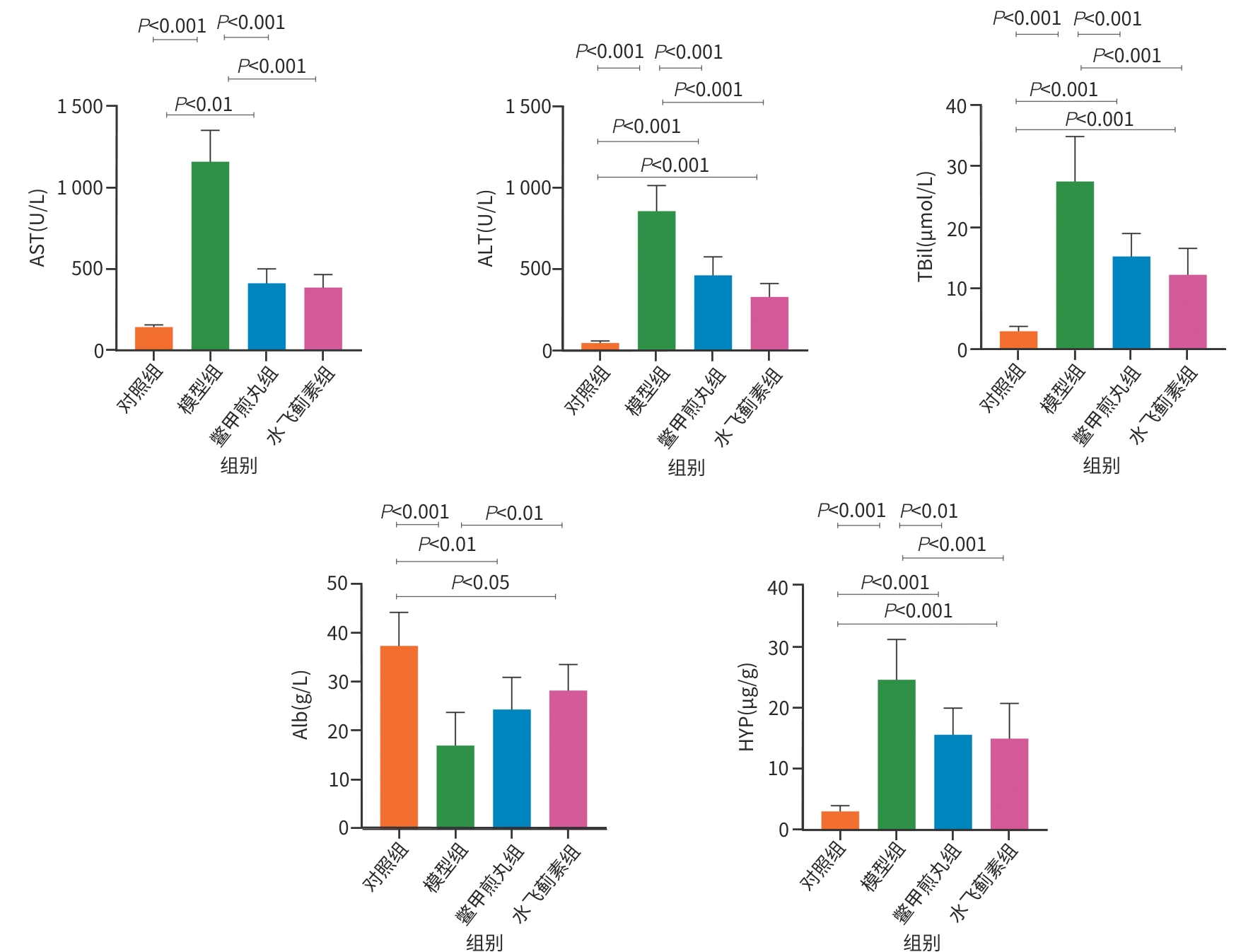
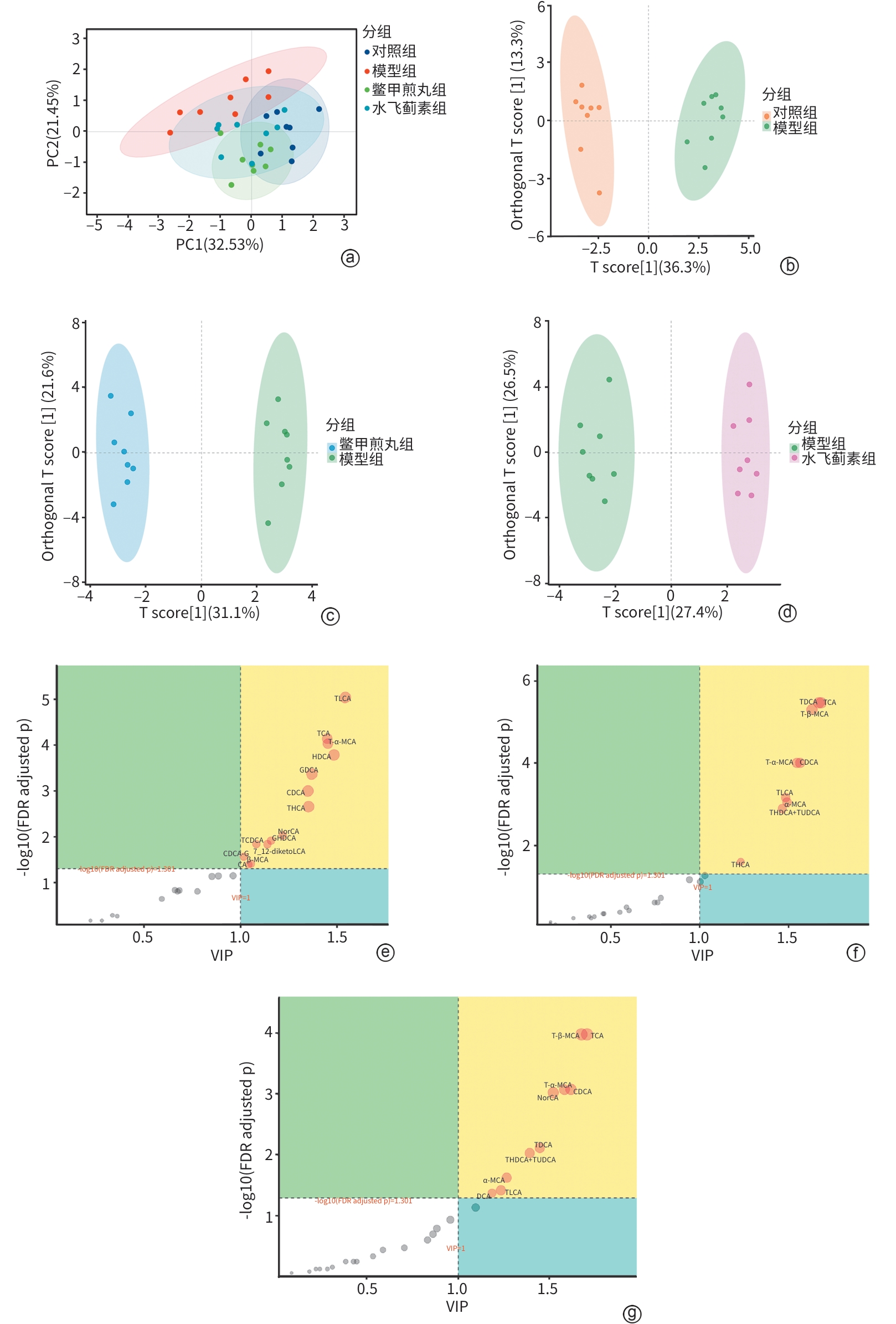
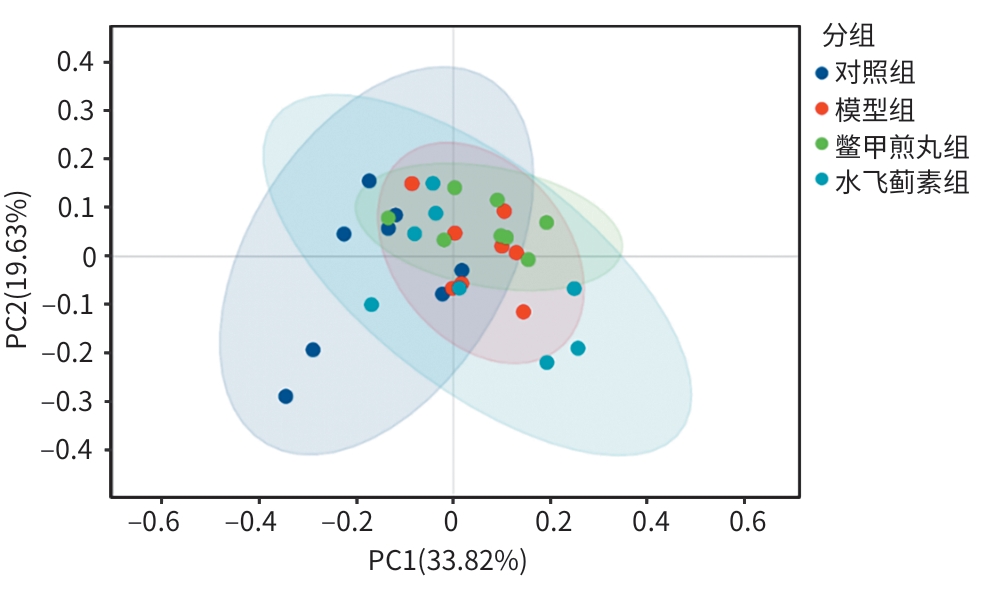
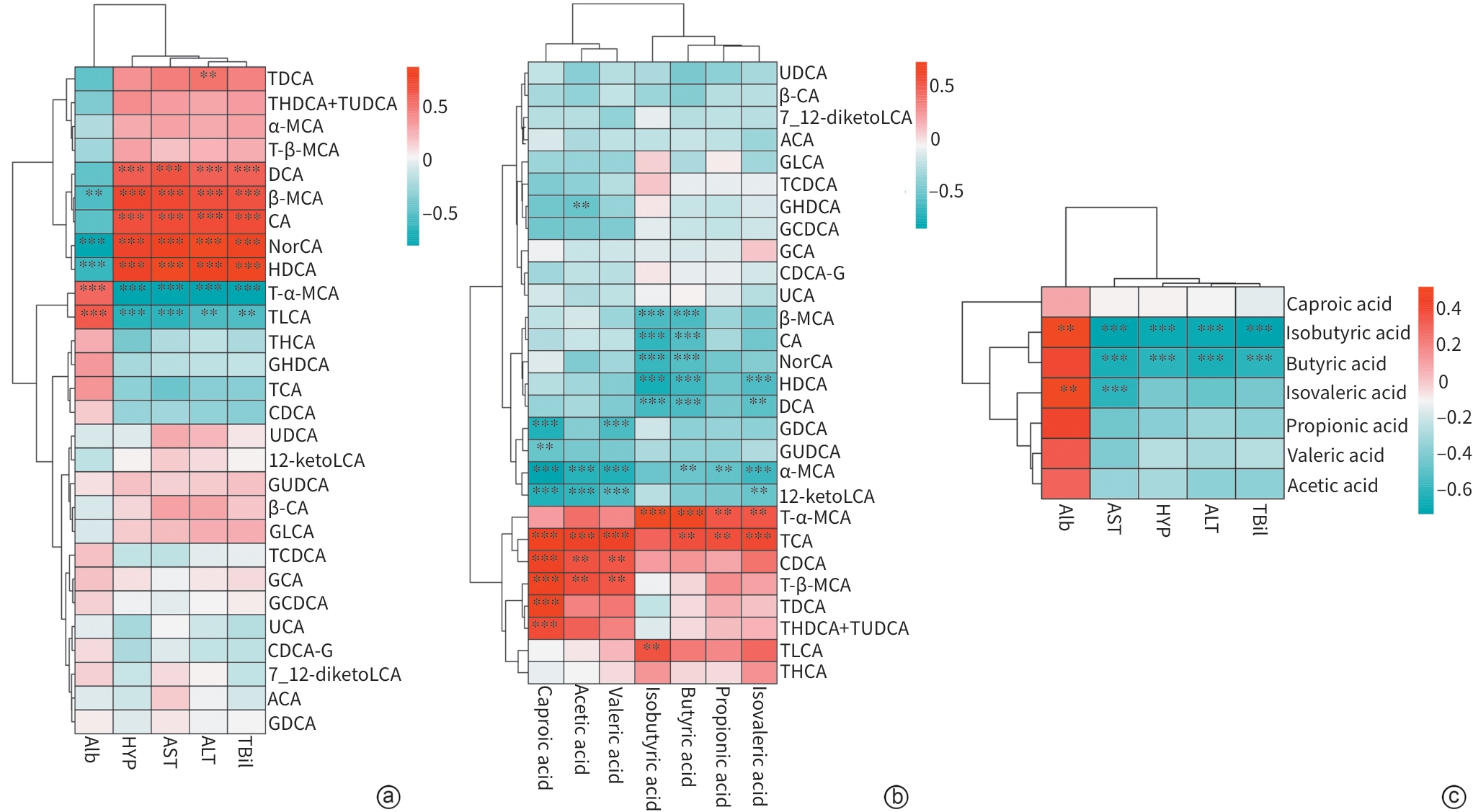
  •   Objective  To investigate the therapeutic effect of Biejiajian Pills on rats with carbon tetrachloride (CCl4)-induced hepatic fibrosis and its mechanism based on the bile acid (BA)-short-chain fatty acid (SCFA) metabolic axis.  Methods  The method of CCl4 induction was used to establish a rat model of hepatic fibrosis, and 32 male Sprague-Dawley rats were randomly divided into control group, model group, Biejiajian Pills group (2.2 g/kg), and silymarin group (43.19 mg/kg), with 8 rats in each group. All rats except those in the control group were given intraperitoneal injection of CCl4 (diluted with corn oil at a ratio of 4∶6, 2 mL/kg) to induce a model of hepatic fibrosis for 8 consecutive weeks, and the rats in the drug administration groups were given the corresponding drug by gavage. An automatic biochemical analyzer was used to measure the serum levels of alanine aminotransferase (ALT), aspartate aminotransferase (AST), total bilirubin (TBil), and albumin (Alb); chloramine-T colorimetry was used to measure the content of hydroxyproline (HYP) in liver tissue; HE staining and Masson staining were used to observe liver histopathological changes; UPLC-MS/MS and GC-MS were used to measure the levels of BAs and SCFAs. The Shapiro-Wilk test and the Levene test were performed for all data to determine normality and homogeneity of variance; a one-way analysis of variance was used for comparison of normally distributed continuous data between multiple groups, and the least significant difference t-test was used for further comparison between two groups; the Kruskal-Wallis H test was used for comparison of Ishak score between groups, and the Dunn’s test was used for further comparison between two groups. The Benjamini-Hochberg method was used for multiple comparison correction in the screening of differentially expressed metabolites in metabolomics data. The variable importance in projection (VIP) values were obtained in combination with the orthogonal partial least squares-discriminant analysis (OPLS-DA) model, and metabolites with VIP>1 and P<0.05 were selected as significantly differentially expressed metabolites between groups. The robustness of the OPLS-DA model was evaluated through 200 permutation tests, and the main parameters of the model were reported, including the interpretation rate of the model for categorical variables (R2Y) and the predictive ability of the model (Q2). A Spearman’s rank correlation analysis was performed.  Results  The results of staining showed ordered arrangement of hepatocytes in the Biejiajian Pills group, with significant alleviation of inflammatory cell infiltration and collagen fiber deposition. Compared with the control group, the model group had significant increases in the serum levels of TBil and HYP and a significant reduction in the serum level of Alb (all P<0.05). Compared with the control group, the Biejiajian Pills group had significant increases in the serum levels of AST, ALT, TBil, and HYP and a significant reduction in the serum level of Alb (all P<0.05), and the silymarin group had significant increases in the serum levels of ALT, TBil, and HYP and a significant reduction in the serum level of Alb (all P<0.05). Compared with the model group, the Biejiajian Pills group had significant reductions in the serum levels of ALT, AST, TBil, and HYP (all P<0.05), and the silymarin group had significant reductions in the serum levels of ALT, TBil, HYP, and AST and a significant increase in the serum level of Alb (all P<0.05). Mechanism studies showed that compared with the control group, the model group had significant reductions in the levels of taurolithocholic acid, tauro-α-muricholic acid, taurocholic acid, glycodeoxycholic acid, taurohyocholic acid, chenodeoxycholic acid, glycohyodeoxycholic acid, 7,12-diketolithocholic acid, taurochenodeoxycholic acid, and glycochenodeoxycholic acid and significant increases in the levels of hyodeoxycholic acid, norcholic acid, β-muricholic acid, and cholic acid (all P<0.05). Compared with the model group, the Biejiajian Pills group had significant increases in the levels of the protective BAs taurolithocholic acid, chenodeoxycholic acid, taurocholic acid, taurohyocholic acid, and taurodeoxycholic acid and significant reductions in the levels of tauro-α-muricholic acid, tauro-β-muricholic acid, taurohyodeoxycholic acid+tauroursodeoxycholic acid, α-muricholic acid, glycoursodeoxycholic acid, and norcholic acid (alll P<0.05). As for SCFAs, compared with the model group, the Biejiajian Pills group had significant increases in the levels of acetic acid, propionic acid, isobutyric acid, butyric acid, isopentanoic acid, pentanoic acid, and hexanoic acid (all P<0.05). Compared with the model group, the silymarin group had significant reductions in the levels of taurolithocholic acid, tauro-α-muricholic acid, norcholic acid, glycocholic acid, deoxycholic acid, tauro-β-muricholic acid, taurodeoxycholic acid, taurohyodeoxycholic acid+tauroursodeoxycholic acid, and α-muricholic acid and significant increases in the levels of taurocholic acid and chenodeoxycholic acid, as well as significant increases in the levels of the SCFAs acetic acid, propionic acid, pentanoic acid, and hexanoic acid (all P<0.05). The correlation analysis showed that the metabolism of BAs and SCFAs was correlated with the changes in serum indicators.  Conclusion  Biejiajian Pills can alleviate CCl4-induced hepatic fibrosis in rats by regulating the BA/SCFA metabolic axis.


  • loading
  • [1]
    Roehlen N, Crouchet E, Baumert T F. Liver fibrosis: Mechanistic concepts and therapeutic perspectives[J]. Cells, 2020, 9( 4): 875. DOI: 10.3390/cells9040875.
    [2]
    Li H. Angiogenesis in the progression from liver fibrosis to cirrhosis and hepatocelluar carcinoma[J]. Expert Rev Gastroenterol Hepatol, 2021, 15( 3): 217- 233. DOI: 10.1080/17474124.2021.1842732.
    [3]
    de Franchis R, Bosch J, Garcia-Tsao G, et al. Baveno VII-Renewing consensus in portal hypertension[J]. J Hepatol, 2022, 76( 4): 959- 974. DOI: 10.1016/j.jhep.2021.12.022.
    [4]
    Arroyo V, Moreau R, Jalan R, et al. Acute-on-chronic liver failure: A new syndrome that will re-classify cirrhosis[J]. J Hepatol, 2015, 62( 1): S131- S143. DOI: 10.1016/j.jhep.2014.11.045.
    [5]
    Vilstrup H, Amodio P, Bajaj J, et al. Hepatic encephalopathy in chronic liver disease: 2014 Practice Guideline by the American Association for the Study of Liver Diseases and the European Association for the Study of the Liver[J]. Hepatology, 2014, 60( 2): 715- 735. DOI: 10.1002/hep.27210.
    [6]
    Llovet J M, Kelley R K, Villanueva A, et al. Hepatocellular carcinoma[J]. Nat Rev Dis Primers, 2021, 7( 1): 6. DOI: 10.1038/s41572-020-00240-3.
    [7]
    Liu Z P, Ouyang G Q, Huang G Z, et al. Global burden of cirrhosis and other chronic liver diseases due to nonalcoholic fatty liver disease, 1990-2019[J]. World J Hepatol, 2023, 15( 11): 1210- 1225. DOI: 10.4254/wjh.v15.i11.1210.
    [8]
    Parada Venegas D, de la Fuente M K, Landskron G, et al. Corrigendum: Short chain fatty acids(SCFAs)-mediated gut epithelial and immune regulation and its relevance for inflammatory bowel diseases[J]. Front Immunol, 2019, 10: 1486. DOI: 10.3389/fimmu.2019.01486.
    [9]
    Chiang J Y L, Ferrell J M. Bile acid metabolism in liver pathobiology[J]. Gene Expr, 2018, 18( 2): 71- 87. DOI: 10.3727/105221618X15156018385515.
    [10]
    Liu Sihong, Li Shasha, Hou Youjuan, et al. Ancient and modern literature on clinical application of Biejia Jianwan in medical treasures of the golden chamber[J]. Chin J Exp Tradit Med Formulae, 2020, 26( 6): 12- 17. DOI: 10.13422/j.cnki.syfjx.20192321.

    刘思鸿, 李莎莎, 侯酉娟, 等.《金匮要略》鳖甲煎丸临床应用的古今文献研究[J]. 中国实验方剂学杂志, 2020, 26( 6): 12- 17. DOI: 10.13422/j.cnki.syfjx.20192321.
    [11]
    Luo Weikang, Wang Xianbei, Wang Jiafeng. Understanding of the synopsis of turtle-fried pill in golden chamber[J]. J Sichuan Tradit Chin Med, 2018, 36( 4): 25- 28.

    罗伟康, 王宪贝, 王加锋. 浅谈对《金匮要略》鳖甲煎丸方证的理解[J]. 四川中医, 2018, 36( 4): 25- 28.
    [12]
    Sun Haitao, Wen Bin, Chen Guanxin, et al. Effect of Biejiajian pill on Wnt/β-catenin pathway associated protein and its target gene expression in liver tissue of hepatic fibrosis model rats[J]. J Tradit Chin Med, 2018, 59( 10): 876- 881. DOI: 10.13288/j.11-2166/r.2018.10.015.

    孙海涛, 文彬, 陈冠新, 等. 鳖甲煎丸对肝纤维化模型大鼠肝组织中Wnt/β-catenin信号通路相关蛋白及其靶基因表达的影响[J]. 中医杂志, 2018, 59( 10): 876- 881. DOI: 10.13288/j.11-2166/r.2018.10.015.
    [13]
    Bataller R, Brenner D A. Liver fibrosis[J]. J Clin Invest, 2005, 115( 2): 209- 218. DOI: 10.1172/jci24282.
    [14]
    Albillos A, de Gottardi A, Rescigno M. The gut-liver axis in liver disease: Pathophysiological basis for therapy[J]. J Hepatol, 2020, 72( 3): 558- 577. DOI: 10.1016/j.jhep.2019.10.003.
    [15]
    Liu Yunxiao, Dou Jing, Wang Xiaozhong. Association between liver fibrosis and gut microbiota based on“harmonizing liver and spleen”[J]. J Clin Hepatol, 2023, 39( 2): 278- 283. DOI: 10.3969/j.issn.1001-5256.2023.02.005.

    刘云霄, 窦婧, 王晓忠. 基于“调和肝脾”论述肝纤维化与肠道菌群的关系[J]. 临床肝胆病杂志, 2023, 39( 2): 278- 283. DOI: 10.3969/j.issn.1001-5256.2023.02.005.
    [16]
    Wiest R, Albillos A, Trauner M, et al. Targeting the gut-liver axis in liver disease[J]. J Hepatol, 2017, 67( 5): 1084- 1103. DOI: 10.1016/j.jhep.2017.05.007.
    [17]
    Koh A, de Vadder F, Kovatcheva-Datchary P, et al. From dietary fiber to host physiology: Short-chain fatty acids as key bacterial metabolites[J]. Cell, 2016, 165( 6): 1332- 1345. DOI: 10.1016/j.cell.2016.05.041.
    [18]
    Seki E, Schwabe R F. Hepatic inflammation and fibrosis: Functional links and key pathways[J]. Hepatology, 2015, 61( 3): 1066- 1079. DOI: 10.1002/hep.27332.
    [19]
    Chen Bin, Xu Jiawei, Peng Jie, et al. Effect of“treating liver by nourishing spleen” on gut microbiota in rats with liver fibrosis based on Xiaoyao powder and its separated recipe[J]. J Clin Hepatol, 2016, 32( 4): 657- 662. DOI: 10.3969/j.issn.1001-5256.2016.04.009.

    陈斌, 徐嘉蔚, 彭杰, 等. 基于逍遥散及其拆方研究“肝病实脾法”对肝纤维化大鼠肠道菌群的影响[J]. 临床肝胆病杂志, 2016, 32( 4): 657- 662. DOI: 10.3969/j.issn.1001-5256.2016.04.009.
    [20]
    Kremer A E, Mayo M J, Hirschfield G M, et al. Seladelpar treatment reduces IL-31 and pruritus in patients with primary biliary cholangitis[J]. Hepatology, 2024, 80( 1): 27- 37. DOI: 10.1097/HEP.0000000000000728.
    [21]
    Peng L Y, Li Z R, Green R S, et al. Butyrate enhances the intestinal barrier by facilitating tight junction assembly via activation of AMP-activated protein kinase in Caco-2 cell monolayers[J]. J Nutr, 2009, 139( 9): 1619- 1625. DOI: 10.3945/jn.109.104638.
    [22]
    Xu Q, Zhang R S, Mu Y, et al. Propionate ameliorates alcohol-induced liver injury in mice via the gut-liver axis: Focus on the improvement of intestinal permeability[J]. J Agric Food Chem, 2022, 70( 20): 6084- 6096. DOI: 10.1021/acs.jafc.2c00633.
    [23]
    Zhang L, Chen J, Ge S J, et al. Propionic acid secreted by Akkermansia muciniphila alleviates hepatic fibrosis by antioxidant regulation across the gut-liver axis[J]. Life Metab, 2026, 5( 1): loaf036. DOI: 10.1093/lifemeta/loaf036.
    [24]
    Zhang C Y, Liu S, Sui Y X, et al. Roles of short-chain fatty acids in metabolic dysfunction-associated steatotic liver disease and metabolic dysfunction-associated steatohepatitis[J]. World J Hepatol, 2025, 17( 11): 113756. DOI: 10.4254/wjh.v17.i11.113756.
  • 加载中

Catalog

    通讯作者: 陈斌, bchen63@163.com
    • 1. 

      沈阳化工大学材料科学与工程学院 沈阳 110142

    1. 本站搜索
    2. 百度学术搜索
    3. 万方数据库搜索
    4. CNKI搜索

    Figures(5)  / Tables(3)

    Article Metrics

    Article views (17) PDF downloads(0) Cited by()
    Proportional views
    Related

    /

    DownLoad:  Full-Size Img  PowerPoint
    Return
    Return