中文English
ISSN 1001-5256 (Print)
ISSN 2097-3497 (Online)
CN 22-1108/R
Volume 42 Issue 8
Aug.  2026
Turn off MathJax
Article Contents

Construction and validation of a machine learning-based risk assessment model for post-transplant diabetes mellitus

DOI: 10.12449/JCH260822
Research funding:

National Natural Science Foundation of China (82470693);

Shanxi Provincial Key Laboratory Project (202204010931008);

Shanxi Key Research and Development Program (202302130501013)

More Information
  • Corresponding author: Xu Jun, junxuty@163.com (ORCID: 0000-0003-3755-9660)
  • Received Date: 2026-02-03
  • Accepted Date: 2026-04-10
  • Published Date: 2026-08-25
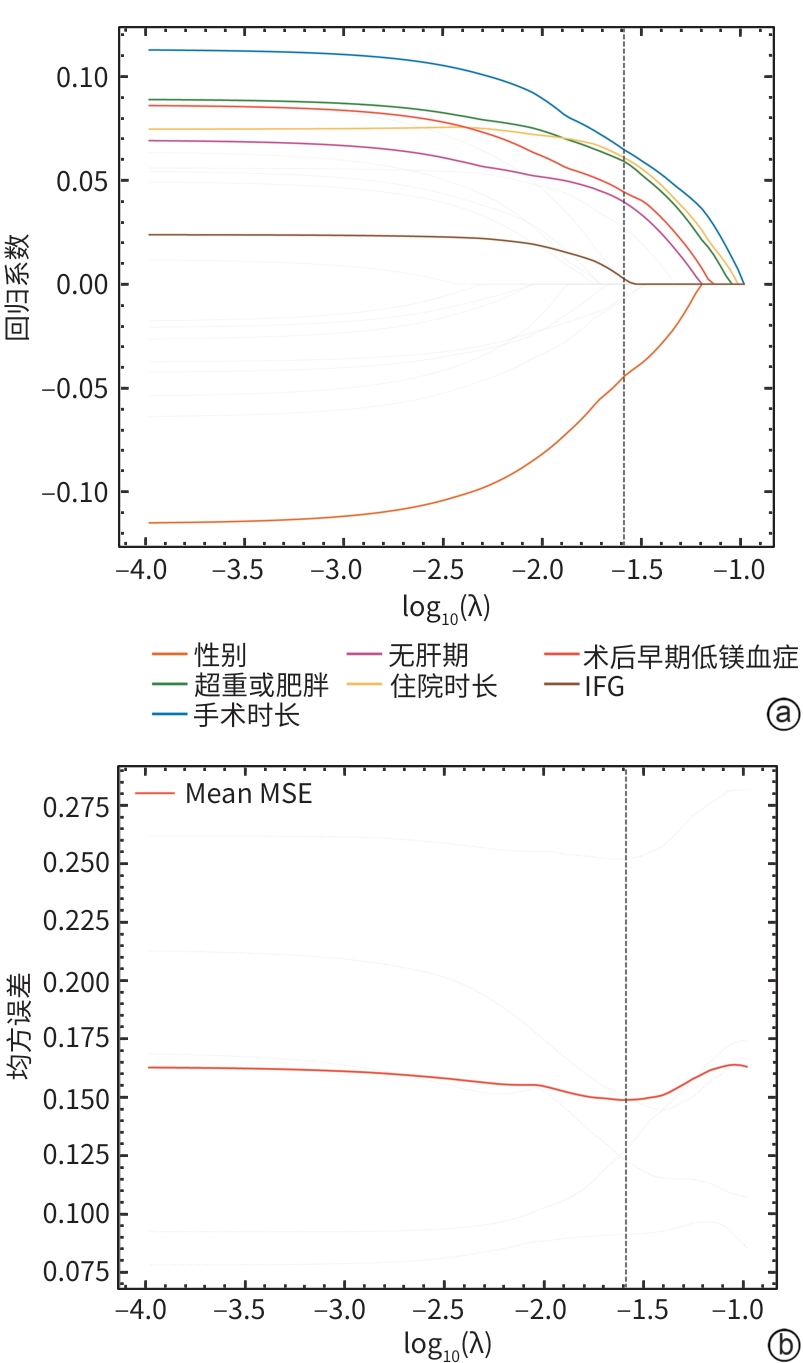
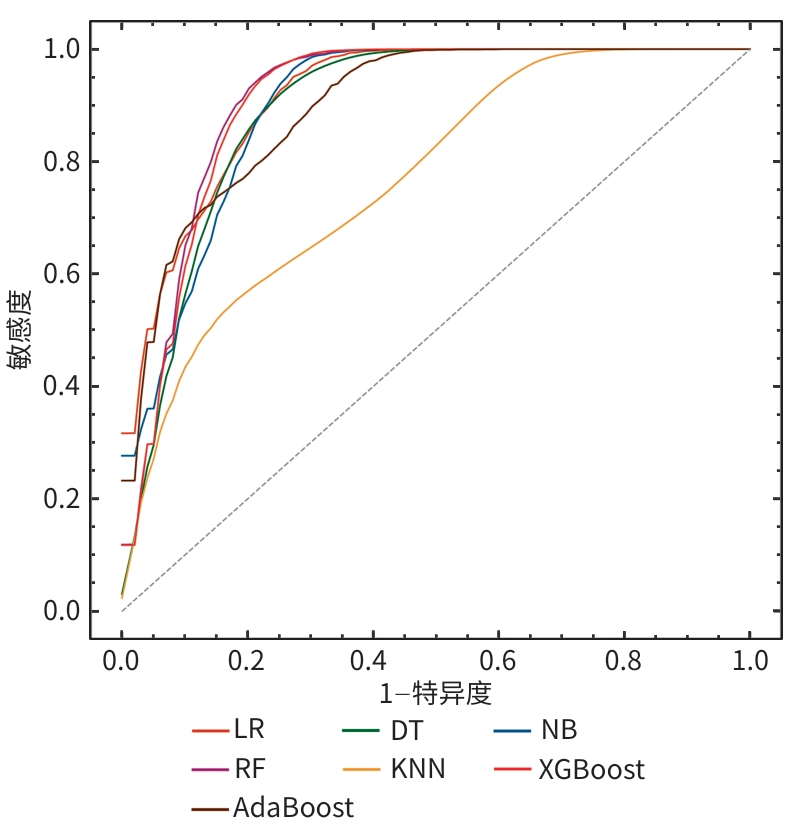
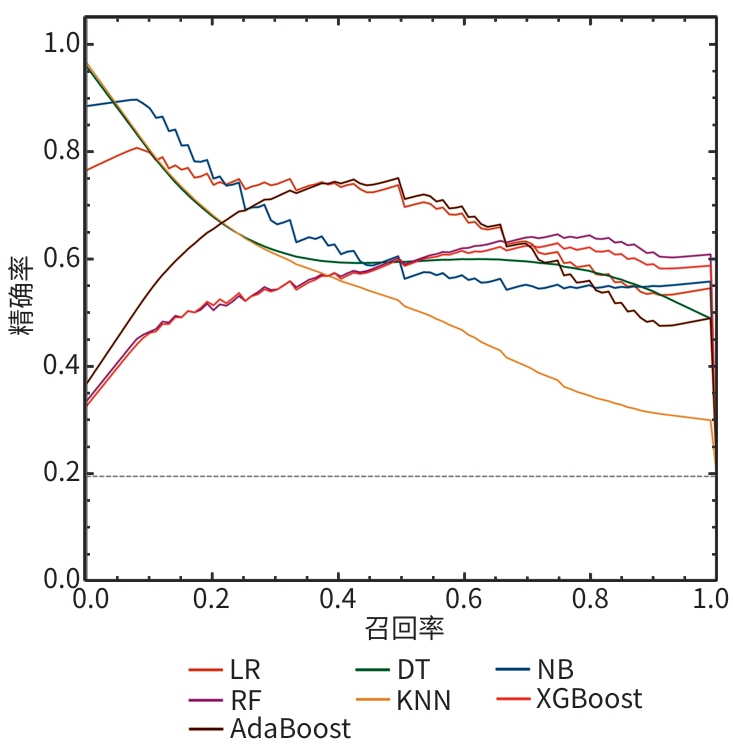
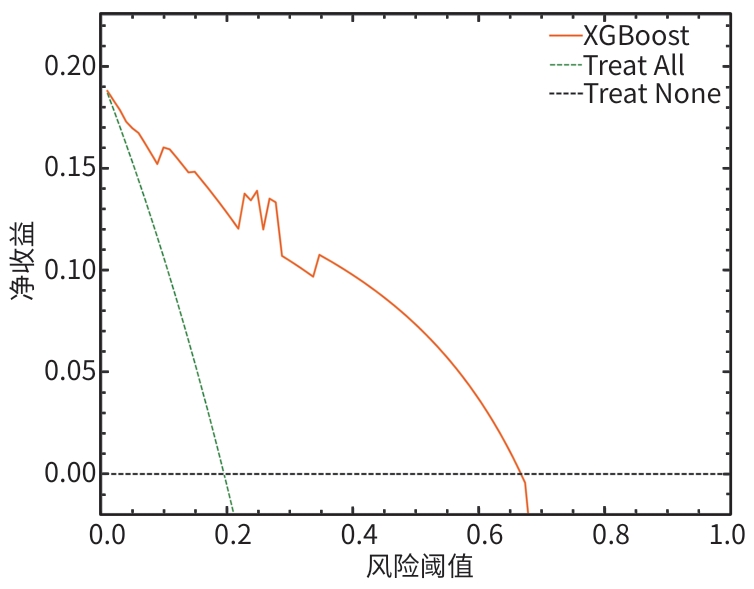
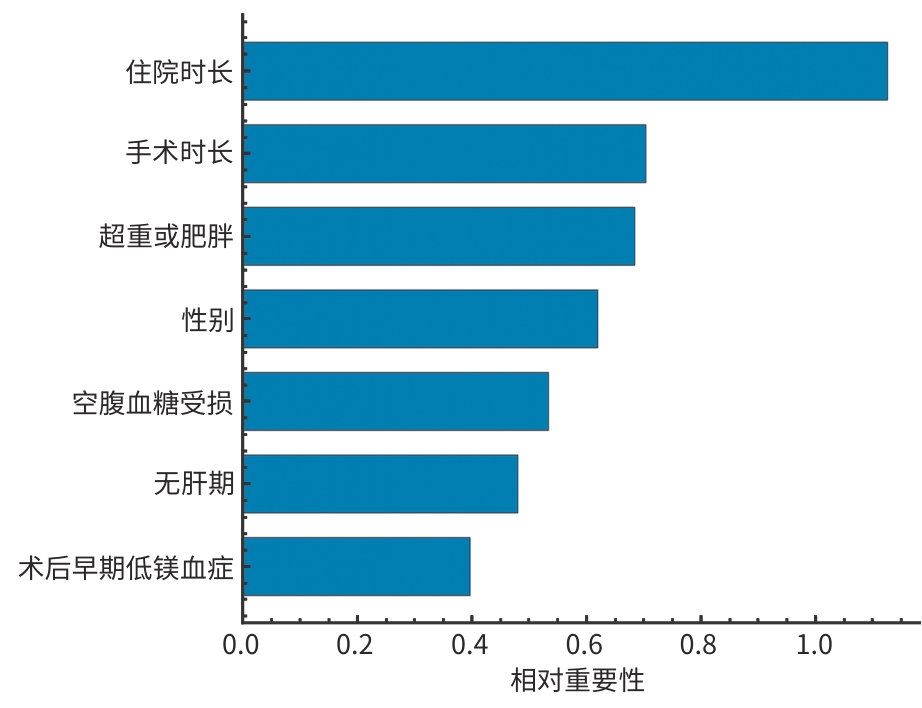
  •   Objective  To construct and validate a risk assessment model for post-transplant diabetes mellitus (PTDM) using multiple machine learning algorithms, and to realize the early identification of PTDM.  Methods  A retrospective analysis was performed for the clinical data of the patients who underwent allogeneic liver transplantation in The First Hospital of Shanxi Medical University from April 1, 2020 to December 31, 2024, and they were randomly divided into a training set and a validation set at a ratio of 7∶3. The LASSO regression analysis combined with 5-fold cross-validation was used for feature selection. Seven machine learning models were developed in the training set, i.e., logistic regression (LR), decision tree (DT), Naive Bayes (NB), random forest (RF), K-nearest neighbor (KNN), extreme gradient boosting (XGBoost), and adaptive boosting (AdaBoost). In the validation set, various methods were used to assess the predictive performance of each model, such as accuracy, precision, recall rate, specificity, F1 score, area under the receiver operating characteristic curve (AUROC), and area under the precision-recall curve (AUPRC). The Brier score and decision curve analysis were used to assess the calibration and clinical practicability of the models, and the SHAP method was used to analyze feature importance. The independent-samples t test or the Wilcoxon rank-sum test was used for comparison of continuous data between two groups, and the chi-square test or the Fisher’s exact test was used for comparison of categorical data between two groups.  Results  A total of 135 liver transplant recipients were enrolled, among whom 26 developed PTDM, and there were 94 patients in the training set and 41 in the validation set. Feature extraction and screening identified 7 key features of sex, overweight or obesity, anhepatic phase, time of operation, length of hospital stay, early postoperative hypomagnesemia, and impaired fasting glucose (IFG). In the validation set, the XGBoost model showed the best predictive performance, with an AUROC of 0.907 (95% confidence interval [CI]: 0.807 — 0.989), an AUPRC of 0.649 (95%CI: 0.339 — 0.955), an accuracy of 0.878, a precision of 0.667, a recall rate of 0.750, an F1-score of 0.706, a specificity of 0.909, and a Brier score of 0.104. The decision curve analysis showed that when the threshold probability was below 0.667, application of the XGBoost model in clinical decision-making provided relatively high net benefit. The SHAP analysis showed that the length of hospital stay ranked first in terms of feature importance, followed by time of operation, overweight or obesity, sex, IFG, anhepatic phase, and early postoperative hypomagnesemia.  Conclusion  The risk assessment model for PTDM in liver transplant recipients based on XGBoost algorithm has excellent performance and can effectively identify high-risk individuals; however, multicenter large-sample data are needed for further validation.


  • loading
  • [1]
    Xia Qiang, Feng Hao. Current status and challenges of liver transplantation oncology[J]. Chin J Dig Surg, 2026, 25( 1): 69- 75. DOI: 10.3760/cma.j.cn115610-20251106-00677.

    夏强, 冯浩. 肝脏移植肿瘤学的现状与挑战[J]. 中华消化外科杂志, 2026, 25( 1): 69- 75. DOI: 10.3760/cma.j.cn115610-20251106-00677.
    [2]
    Chen Yining, Xiao Yun, Han Xiaoyu, et al. Diagnosis and individualized drug therapy for the rejection with hy-perglycemia after liver Transplantation[J]. Chin J Clin Pharmacol Ther, 2023, 28( 5): 550- 555. DOI: 10.12092/j.issn.1009-2501.2023.05.009.

    陈以宁, 肖云, 韩晓雨, 等. 肝移植术后排斥合并高血糖的诊治和用药的实践与思考[J]. 中国临床药理学与治疗学, 2023, 28( 5): 550- 555. DOI: 10.12092/j.issn.1009-2501.2023.05.009.
    [3]
    Chin Y H, Tan H Q M, Ng C H, et al. A time-based meta-analysis on the incidence of new onset diabetes after liver transplantation[J]. J Clin Med, 2021, 10( 5): 1045. DOI: 10.3390/jcm10051045.
    [4]
    Ling Q, Xu X, Xie H Y, et al. New-onset diabetes after liver transplantation: A national report from China Liver Transplant Registry[J]. Liver Int, 2016, 36( 5): 705- 712. DOI: 10.1111/liv.13042.
    [5]
    Richardson B, Khan M Q, Brown S A, et al. Personalizing diabetes management in liver transplant recipients: The new era for optimizing risk management[J]. Hepatol Commun, 2022, 6( 6): 1250- 1261. DOI: 10.1002/hep4.1876.
    [6]
    Sarabhai T, Mathew A, Rashidi-Alavijeh J, et al. Diabetes mellitus and osteoporosis after organ transplantation: Frequency, clinical features, and treatment[J]. Dtsch Arztebl Int, 2026, 123( 10): 281- 288. DOI: 10.3238/arztebl.m2026.0019.
    [7]
    Park S S, Koo B K, Park S, et al. Impact of new-onset diabetes after transplantation on cardiovascular risk and mortality in Korea: A nationwide population-based study[J]. Diabetes Metab J, 2025, 49( 1): 117- 127. DOI: 10.4093/dmj.2024.0078.
    [8]
    Liu Yingchun, Yang Bin. Research progress on the application of artificial intelligence in liver transplantation[J]. Organ Transplant, 2024, 15( 6): 883- 888. DOI: 10.3969/j.issn.1674-7445.2024084.

    刘迎春, 杨斌. 人工智能在肝移植中的应用研究进展[J]. 器官移植, 2024, 15( 6): 883- 888. DOI: 10.3969/j.issn.1674-7445.2024084.
    [9]
    Sharif A, Hecking M, de Vries A P, et al. Proceedings from an international consensus meeting on posttransplantation diabetes mellitus: Recommendations and future directions[J]. Am J Transplant, 2014, 14( 9): 1992- 2000. DOI: 10.1111/ajt.12850.
    [10]
    Dong Junfeng, Xue Qiang, Teng Fei, et al. Research progress in risk factors of post-transplantation diabetes mellitus[J]. Organ Transplant, 2024, 15( 1): 145- 150. DOI: 10.3969/j.issn.1674-7445.2023154.

    董骏峰, 薛强, 滕飞, 等. 移植后糖尿病危险因素研究进展[J]. 器官移植, 2024, 15( 1): 145- 150. DOI: 10.3969/j.issn.1674-7445.2023154.
    [11]
    Branch of Organ Transplantation of Chinese Medical Association. Diagnosis and treatment specification for immunosuppressive therapy and rejection of liver transplantation in China(2019 edition)[J]. Organ Transplant, 2021, 12( 1): 8- 14, 28. DOI: 10.3969/j.issn.1674-7445.2021.01.002.

    中华医学会器官移植学分会. 中国肝移植免疫抑制治疗与排斥反应诊疗规范(2019版)[J]. 器官移植, 2021, 12( 1): 8- 14, 28. DOI: 10.3969/j.issn.1674-7445.2021.01.002.
    [12]
    Shimada S, Miyake K, Venkat D, et al. Clinical characteristics of new-onset diabetes after liver transplantation and outcomes[J]. Ann Gastroenterol Surg, 2024, 8( 3): 383- 393. DOI: 10.1002/ags3.12775.
    [13]
    Li D W, Lu T F, Hua X W, et al. Risk factors for new onset diabetes mellitus after liver transplantation: A meta-analysis[J]. World J Gastroenterol, 2015, 21( 20): 6329- 6340. DOI: 10.3748/wjg.v21.i20.6329.
    [14]
    Dascal R, Wiebe C, Niazi M, et al. Post-transplant diabetes mellitus in Canadian liver and renal transplant recipients[J]. Can Liver J, 2022, 5( 4): 466- 475. DOI: 10.3138/canlivj-2022-0010.
    [15]
    Liang J, Yi X L, Xue M J, et al. A retrospective cohort study of preoperative lipid indices and their impact on new-onset diabetes after liver transplantation[J]. J Clin Lab Anal, 2020, 34( 5): e23192. DOI: 10.1002/jcla.23192.
    [16]
    Shang Ying, Shao Fei, Kong Xinjuan. An analysis of risk factors for the development of diabetes mellitus after orthotopic liver transplantation in adults[J]. J Precis Med, 2024, 39( 4): 341- 345, 351. DOI: 10.13362/j.jpmed.202404013.

    尚莹, 邵非, 孔心涓. 成人原位肝移植术后糖尿病发生的危险因素分析[J]. 精准医学杂志, 2024, 39( 4): 341- 345, 351. DOI: 10.13362/j.jpmed.202404013.
    [17]
    Bai R P, An R, Chen S Y, et al. Risk factors and prediction score for new-onset diabetes mellitus after liver transplantation[J]. J Diabetes Investig, 2024, 15( 8): 1105- 1114. DOI: 10.1111/jdi.14204.
    [18]
    Chen S J, Bowen D G, Liu K, et al. Hypomagnesaemia, an independent risk factor for the development of post-transplant diabetes mellitus in liver and renal transplant recipients A systematic review[J]. J Hum Nutr Diet, 2024, 37( 6): 1407- 1419. DOI: 10.1111/jhn.13354.
    [19]
    Porrini E L, Díaz J M, Moreso F, et al. Clinical evolution of post-transplant diabetes mellitus[J]. Nephrol Dial Transplant, 2016, 31( 3): 495- 505. DOI: 10.1093/ndt/gfv368.
    [20]
    Lou Lianyu, Li Shujuan, Zhang Bingliang, et al. Construction and validation of a random forest-based prediction model for post-liver transplant diabetes mellitus[J]. J Nurs, 2026, 33( 1): 60- 67. DOI: 10.16460/j.issn2097-6569.2026.01.060.

    娄连玉, 李树娟, 张丙良, 等. 基于随机森林的肝移植术后糖尿病风险预测模型的构建与验证[J]. 护理学报, 2026, 33( 1): 60- 67. DOI: 10.16460/j.issn2097-6569.2026.01.060.
    [21]
    Loosen S H, Krieg S, Chaudhari S, et al. Prediction of new-onset diabetes mellitus within 12 months after liver transplantation-a machine learning approach[J]. J Clin Med, 2023, 12( 14): 4877. DOI: 10.3390/jcm12144877.
    [22]
    Liang Zhixing, Ye Linsen, Yang Yang. Application of artificial intelligence in liver transplantation[J]. J Clin Hepatol, 2022, 38( 1): 30- 34. DOI: 10.3969/j.issn.2095-5332.2024.06.016.

    梁智星, 叶林森, 杨扬. 人工智能在肝移植中的应用[J]. 临床肝胆病杂志, 2022, 38( 1): 30- 34. DOI: 10.3969/j.issn.2095-5332.2024.06.016.
  • 加载中

Catalog

    通讯作者: 陈斌, bchen63@163.com
    • 1. 

      沈阳化工大学材料科学与工程学院 沈阳 110142

    1. 本站搜索
    2. 百度学术搜索
    3. 万方数据库搜索
    4. CNKI搜索

    Figures(5)  / Tables(3)

    Article Metrics

    Article views (10) PDF downloads(0) Cited by()
    Proportional views
    Related

    /

    DownLoad:  Full-Size Img  PowerPoint
    Return
    Return