| [1] |
Hoofnagle J H, Björnsson E S. Drug-induced liver injury-types and phenotypes[J]. N Engl J Med, 2019, 381( 3): 264- 273. DOI: 10.1056/NEJMra1816149. |
| [2] |
Shen T, Liu Y X, Shang J, et al. Incidence and etiology of drug-induced liver injury in China’s mainland[J]. Gastroenterology, 2019, 156( 8): 2230- 2241. DOI: 10.1053/j.gastro.2019.02.002. |
| [3] |
|
| [4] |
Pedre B, Barayeu U, Ezeriņa D, et al. The mechanism of action of N-acetylcysteine(NAC): The emerging role of H 2S and sulfane sulfur species[J]. Pharmacol Ther, 2021, 228: 107916. DOI: 10.1016/j.pharmthera.2021.107916. |
| [5] |
Jaeschke H, McGill M R, Ramachandran A. Oxidant stress, mitochondria, and cell death mechanisms in drug-induced liver injury: Lessons learned from acetaminophen hepatotoxicity[J]. Drug Metab Rev, 2012, 44( 1): 88- 106. DOI: 10.3109/03602532.2011.602688. |
| [6] |
Krenkel O, Mossanen J C, Tacke F. Immune mechanisms in acetaminophen-induced acute liver failure[J]. Hepatobiliary Surg Nutr, 2014, 3( 6): 331- 343. DOI: 10.3978/j.issn.2304-3881.2014.11.01. |
| [7] |
Uzi D, Barda L, Scaiewicz V, et al. CHOP is a critical regulator of acetaminophen-induced hepatotoxicity[J]. J Hepatol, 2013, 59( 3): 495- 503. DOI: 10.1016/j.jhep.2013.04.024. |
| [8] |
Ni H M, McGill M R, Chao X J, et al. Removal of acetaminophen protein adducts by autophagy protects against acetaminophen-induced liver injury in mice[J]. J Hepatol, 2016, 65( 2): 354- 362. DOI: 10.1016/j.jhep.2016.04.025. |
| [9] |
DeLeve L D, Maretti-Mira A C. Liver sinusoidal endothelial cell: An update[J]. Semin Liver Dis, 2017, 37( 4): 377- 387. DOI: 10.1055/s-0037-1617455. |
| [10] |
Shetty S, Lalor P F, Adams D H. Liver sinusoidal endothelial cells- gatekeepers of hepatic immunity[J]. Nat Rev Gastroenterol Hepatol, 2018, 15( 9): 555- 567. DOI: 10.1038/s41575-018-0020-y. |
| [11] |
McConnell M J, Kostallari E, Ibrahim S H, et al. The evolving role of liver sinusoidal endothelial cells in liver health and disease[J]. Hepatology, 2023, 78( 2): 649- 669. DOI: 10.1097/HEP.0000000000000207. |
| [12] |
Gracia-Sancho J, Caparrós E, Fernández-Iglesias A, et al. Role of liver sinusoidal endothelial cells in liver diseases[J]. Nat Rev Gastroenterol Hepatol, 2021, 18( 6): 411- 431. DOI: 10.1038/s41575-020-00411-3. |
| [13] |
Shimada H, Yokotobi A, Yamamoto N, et al. Inhibition of 15-prostaglandin dehydrogenase attenuates acetaminophen-induced liver injury via suppression of apoptosis in liver endothelial cells[J]. Prostaglandins Leukot Essent Fat Acids, 2024, 202: 102640. DOI: 10.1016/j.plefa.2024.102640. |
| [14] |
Rajala R, Cleuren A C A, Griffin C T. Acetaminophen overdose reveals PAR4 as a low-expressing but potent receptor on the hepatic endothelium in mice[J]. Arterioscler Thromb Vasc Biol, 2025, 45( 1): 53- 71. DOI: 10.1161/ATVBAHA.124.321353. |
| [15] |
Wang H L, Burke L J, Patel J, et al. Imaging-based vascular-related biomarkers for early detection of acetaminophen-induced liver injury[J]. Theranostics, 2020, 10( 15): 6715- 6727. DOI: 10.7150/thno.44900. |
| [16] |
You K, Wang Y, Chen X X, et al. Neutralizing serum amyloid a protects against sinusoidal endothelial cell damage and platelet aggregation during acetaminophen-induced liver injury[J]. Biochem Biophys Res Commun, 2023, 639: 20- 28. DOI: 10.1016/j.bbrc.2022.11.079. |
| [17] |
Gao S Q, Silasi-Mansat R, Behar A R, et al. Excessive plasmin compromises hepatic sinusoidal vascular integrity after acetaminophen overdose[J]. Hepatology, 2018, 68( 5): 1991- 2003. DOI: 10.1002/hep.30070. |
| [18] |
Yang Y L, Sangwung P, Kondo R, et al. Alcohol-induced Hsp90 acetylation is a novel driver of liver sinusoidal endothelial dysfunction and alcohol-related liver disease[J]. J Hepatol, 2021, 75( 2): 377- 386. DOI: 10.1016/j.jhep.2021.02.028. |
| [19] |
Kaczara P, Czyzynska-Cichon I, Kus E, et al. Liver sinusoidal endothelial cells rely on oxidative phosphorylation but avoid processing long-chain fatty acids in their mitochondria[J]. Cell Mol Biol Lett, 2024, 29( 1): 67. DOI: 10.1186/s11658-024-00584-8. |
| [20] |
Jaeschke H, Adelusi O B, Akakpo J Y, et al. Recommendations for the use of the acetaminophen hepatotoxicity model for mechanistic studies and how to avoid common pitfalls[J]. Acta Pharm Sin B, 2021, 11( 12): 3740- 3755. DOI: 10.1016/j.apsb.2021.09.023. |
| [21] |
Li R S, Wu H J, Xu Y, et al. Underlying mechanisms and treatment of acetaminophen-induced liver injury(Review)[J]. Mol Med Rep, 2025, 31( 4): 106. DOI: 10.3892/mmr.2025.13471. |
| [22] |
Badmann A, Langsch S, Keogh A, et al. TRAIL enhances paracetamol-induced liver sinusoidal endothelial cell death in a Bim- and Bid-dependent manner[J]. Cell Death Dis, 2012, 3( 12): e447. DOI: 10.1038/cddis.2012.185. |
| [23] |
Teratani T, Tomita K, Suzuki T, et al. Free cholesterol accumulation in liver sinusoidal endothelial cells exacerbates acetaminophen hepatotoxicity via TLR9 signaling[J]. J Hepatol, 2017, 67( 4): 780- 790. DOI: 10.1016/j.jhep.2017.05.020. |
| [24] |
Jaeschke H, Umbaugh D S, Ramachandran A. Role of pyroptosis in acetaminophen-induced hepatotoxicity[J]. Livers, 2022, 2( 4): 425- 435. DOI: 10.3390/livers2040032. |
| [25] |
Crosswhite P L, Podsiadlowska J J, Curtis C D, et al. CHD4-regulated plasmin activation impacts lymphovenous hemostasis and hepatic vascular integrity[J]. J Clin Invest, 2016, 126( 6): 2254- 2266. DOI: 10.1172/JCI84652. |
| [26] |
Lin Y, Wozniak J M, Grimsey N J, et al. Phosphoproteomic analysis of protease-activated receptor-1 biased signaling reveals unique modulators of endothelial barrier function[J]. Proc Natl Acad Sci U S A, 2020, 117( 9): 5039- 5048. DOI: 10.1073/pnas.1917295117. |
| [27] |
Buglak D B, Bougaran P, Kulikauskas M R, et al. Nuclear SUN1 stabilizes endothelial cell junctions via microtubules to regulate blood vessel formation[J]. eLife, 2023, 12: e83652. DOI: 10.7554/eLife.83652. |
| [28] |
Porto H K P, Grando M D, Ramalho L N Z, et al. Exposure to acetaminophen impairs vasodilation, increases oxidative stress and changes arterial morphology of rats[J]. Arch Toxicol, 2019, 93( 7): 1955- 1964. DOI: 10.1007/s00204-019-02463-0. |
| [29] |
Li M, Sun X H, Zhao J, et al. CCL5 deficiency promotes liver repair by improving inflammation resolution and liver regeneration through M2 macrophage polarization[J]. Cell Mol Immunol, 2020, 17( 7): 753- 764. DOI: 10.1038/s41423-019-0279-0. |
| [30] |
Poisson J, Lemoinne S, Boulanger C, et al. Liver sinusoidal endothelial cells: Physiology and role in liver diseases[J]. J Hepatol, 2017, 66( 1): 212- 227. DOI: 10.1016/j.jhep.2016.07.009. |
| [31] |
Woolbright B L, Jaeschke H. Role of the inflammasome in acetaminophen-induced liver injury and acute liver failure[J]. J Hepatol, 2017, 66( 4): 836- 848. DOI: 10.1016/j.jhep.2016.11.017. |
| [32] |
Xie D N, Guo H L, Li M B, et al. Splenic monocytes mediate inflammatory response and exacerbate myocardial ischemia/reperfusion injury in a mitochondrial cell-free DNA-TLR9-NLRP3-dependent fashion[J]. Basic Res Cardiol, 2023, 118( 1): 44. DOI: 10.1007/s00395-023-01014-0. |
| [33] |
Michalopoulos G K, Bhushan B. Liver regeneration: Biological and pathological mechanisms and implications[J]. Nat Rev Gastroenterol Hepatol, 2021, 18( 1): 40- 55. DOI: 10.1038/s41575-020-0342-4. |
| [34] |
Bhushan B, Chavan H, Borude P, et al. Dual role of epidermal growth factor receptor in liver injury and regeneration after acetaminophen overdose in mice[J]. Toxicol Sci, 2017, 155( 2): 363- 378. DOI: 10.1093/toxsci/kfw213. |
| [35] |
Hu S K, Liu S, Bian Y, et al. Single-cell spatial transcriptomics reveals a dynamic control of metabolic zonation and liver regeneration by endothelial cell Wnt2 and Wnt9b[J]. Cell Rep Med, 2022, 3( 10): 100754. DOI: 10.1016/j.xcrm.2022.100754. |
| [36] |
Ben-Moshe S, Veg T, Manco R, et al. The spatiotemporal program of zonal liver regeneration following acute injury[J]. Cell Stem Cell, 2022, 29( 6): 973- 989.e10. DOI: 10.1016/j.stem.2022.04.008. |
| [37] |
Xu C Y, Jiang J, An Y, et al. Angiotensin II type-2 receptor signaling facilitates liver injury repair and regeneration via inactivation of Hippo pathway[J]. Acta Pharmacol Sin, 2024, 45( 6): 1201- 1213. DOI: 10.1038/s41401-024-01249-0. |
| [38] |
Forbes S J, Newsome P N. Liver regeneration-mechanisms and models to clinical application[J]. Nat Rev Gastroenterol Hepatol, 2016, 13( 8): 473- 485. DOI: 10.1038/nrgastro.2016.97. |
| [39] |
Groeneveld D, Cline-Fedewa H, Baker K S, et al. Von Willebrand factor delays liver repair after acetaminophen-induced acute liver injury in mice[J]. J Hepatol, 2020, 72( 1): 146- 155. DOI: 10.1016/j.jhep.2019.09.030. |
| [40] |
Chauhan A, Sheriff L, Hussain M T, et al. The platelet receptor CLEC-2 blocks neutrophil mediated hepatic recovery in acetaminophen induced acute liver failure[J]. Nat Commun, 2020, 11( 1): 1939. DOI: 10.1038/s41467-020-15584-3. |
| [41] |
Gao J H, Lan T, Kostallari E, et al. Angiocrine signaling in sinusoidal homeostasis and liver diseases[J]. J Hepatol, 2024, 81( 3): 543- 561. DOI: 10.1016/j.jhep.2024.05.014. |
| [42] |
Rani J, Dhull S B, Rose P K, et al. Drug-induced liver injury and anti-hepatotoxic effect of herbal compounds: A metabolic mechanism perspective[J]. Phytomedicine, 2024, 122: 155142. DOI: 10.1016/j.phymed.2023.155142. |


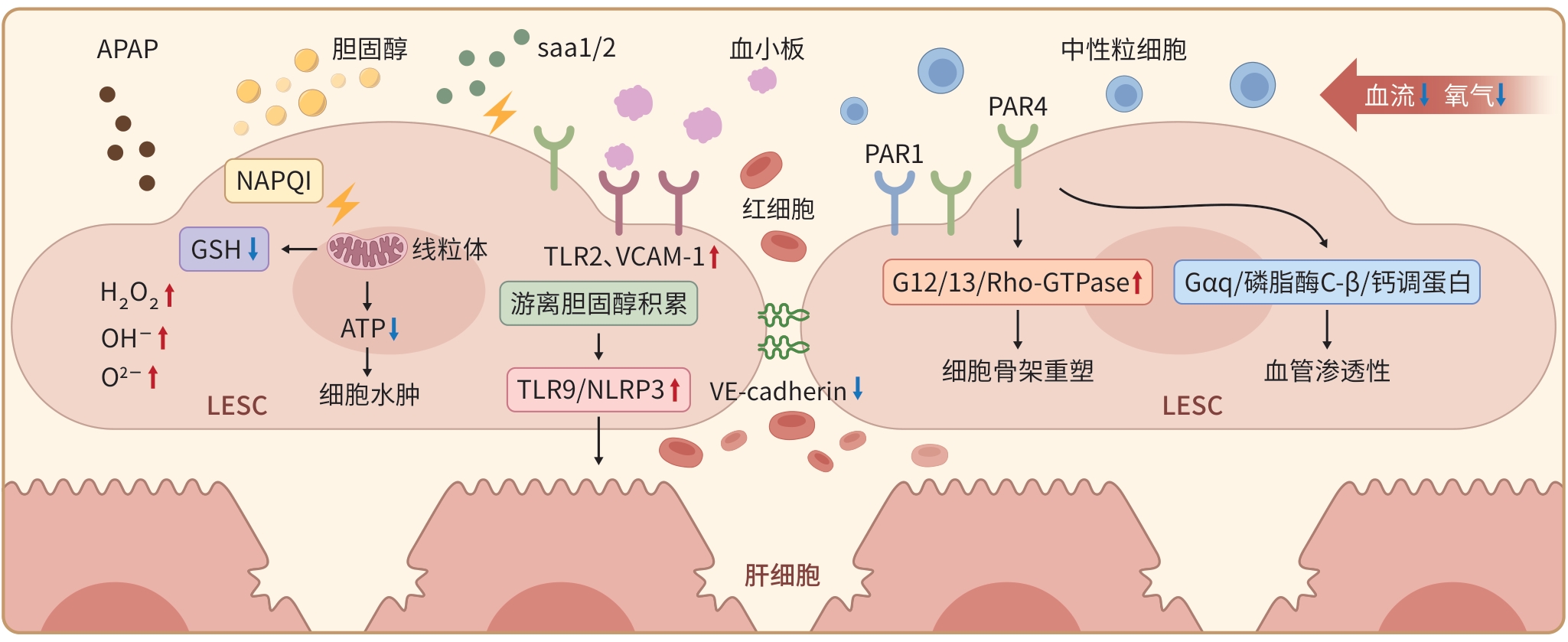







 DownLoad: